How to read a certificate of analysis — what purity actually means on a peptide vial
A purity figure on a peptide certificate is a percentage of chromatogram area, not a statement about everything in the vial. What HPLC measures, what mass spectrometry measures instead, and the one check worth doing the moment a delivery arrives.
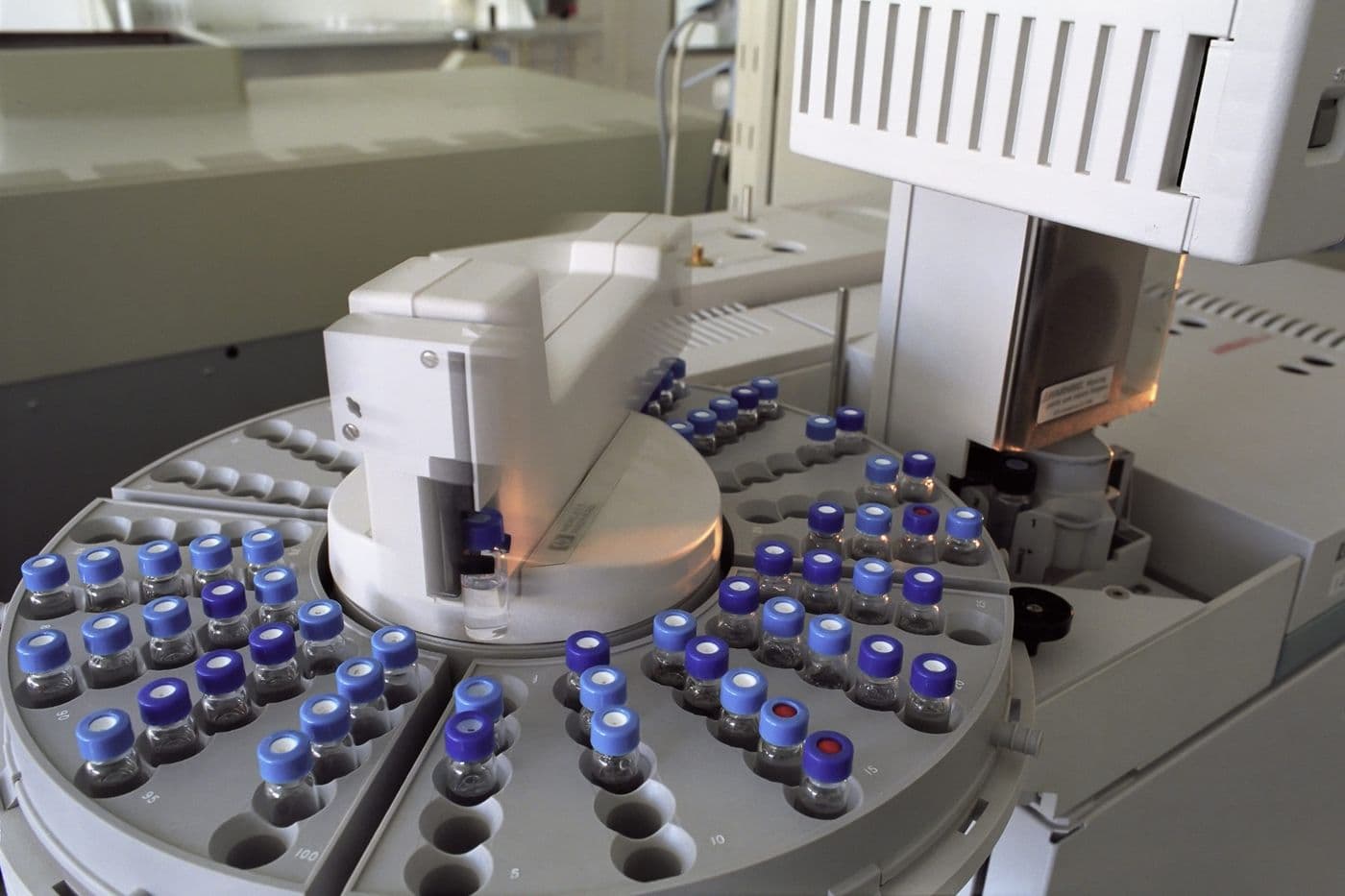
A certificate of analysis is a record of what was measured on one batch of material, by whom, and by which method. It is not a warranty and it is not a specification. A specification states what a batch is supposed to be; a certificate states what one particular batch was found to be on the day a sample of it was tested. Read that way the document is genuinely useful. Read as a badge, it says almost nothing.
Nearly every certificate that arrives with a peptide vial leads with a single number — a purity figure, usually somewhere above 98%. That number is the most quoted and the least examined thing on the page. What follows is an account of what it is a percentage of, what the other analyses on the sheet are for, and which single check on arrival is worth more than the rest of the document put together.
691 mg/g
Assigned purity of a candidate certified reference material
angiotensin II · ± 9 mg/g (k = 2) (2)
≈25%
Share of that same material's mass carried by trifluoroacetate
measured by fluorine-19 qNMR (2)
30×
Tryptophan's molar absorbance at 214 nm against one peptide bond
detector response is not uniform (4)
What a purity figure is a percentage of
On a peptide certificate, purity is almost always a chromatographic figure. A sample is separated by reversed-phase HPLC, a detector records what comes off the column against time, and the resulting peaks are integrated. The purity figure is the area of the main peak expressed against the total area of every peak the detector registered. McCarthy and colleagues describe the same arithmetic from the reference-standard side, where the impurity total is the sum of the detected impurity peak areas over the total detected area (3). Pharmacopoeial limits are written in those terms too: the United States Pharmacopeia monograph for calcitonin salmon sets individual impurities at not more than 3.0% and total impurities at not more than 5.0% of the total area of all chromatographic peaks, as reported by Zeng and colleagues (5).
So a certificate reading 99.5% says that 99.5% of the absorbance the instrument integrated belonged to one peak. It does not say that 99.5% of the mass in the vial is peptide. Those are two different statements, and only the first one has been measured.
Two things open the gap. The first is that the detector does not respond equally to everything it sees. Peptides without aromatic residues are commonly monitored near 214 nm, where the peptide bond itself absorbs; Kuipers and Gruppen measured the peptide bond's molar extinction coefficient at that wavelength as 923 M⁻¹ cm⁻¹ and found tryptophan absorbing roughly thirty times more strongly, with phenylalanine, tyrosine and histidine about six times more (4). An impurity rich in tryptophan is over-represented in the area count; one without it is under-represented.
The second is that a chromatogram counts only what reaches the detector as a resolved peak. Anything that does not elute, that co-elutes underneath the main peak, or that carries no chromophore at the monitored wavelength is absent from the arithmetic rather than counted against it. Zeng and colleagues put the consequence plainly for regulated peptide products, reporting that many of the HPLC-UV quality-control methods submitted for peptide drugs did not appear adequate to distinguish and quantify process impurities and degradation products, and that a high-resolution mass spectrometry method detected more peptide-related impurities in a calcitonin salmon nasal solution than the pharmacopoeial HPLC-UV method did (5).
Two analyses, two different questions
HPLC and mass spectrometry are not two ways of measuring the same thing. Each answers a question the other cannot, and a certificate carrying only one of them leaves the other question open.
| Parameter | HPLC | Mass spectrometry |
|---|---|---|
| The question it answers | How much of what came off the column was a single substance? | Is that substance the molecule it is supposed to be? |
| What is physically measured | Detector absorbance over time, integrated peak by peak | The mass-to-charge ratio of the ionised material (7) |
| Usual configuration | Reversed-phase separation with UV detection near 214 nm, where the peptide bond absorbs (4) | Electrospray or matrix-assisted laser desorption ionisation, coupled to a mass analyser (7) |
| How the result is expressed | A percentage of the total detected peak area (3) | An observed mass, set against the mass calculated from the sequence |
| What it cannot establish alone | Whether the main peak is the intended peptide at all | What proportion of the material the intended peptide represents |
| Why the pair is stronger than either | It separates and quantifies, and a high-resolution mass method has been reported to resolve impurities a pharmacopoeial UV method did not (5) | In the quality control of synthetic peptides it is described as the method for evaluating authenticity and integrity, with the sequence already known (6) |
Sources. (1) D'Hondt M, Bracke N, Taevernier L, et al. Related impurities in peptide medicines. J Pharm Biomed Anal. 2014;101:2–30. (2) Melanson JE, Thibeault MP, Stocks BB, et al. Purity assignment for peptide certified reference materials by combining qNMR and LC-MS/MS amino acid analysis results: application to angiotensin II. Anal Bioanal Chem. 2018;410(26):6719–6731. (3) McCarthy D, Han Y, Carrick K, et al. Reference Standards to Support Quality of Synthetic Peptide Therapeutics. Pharm Res. 2023;40(6):1317–1328. (4) Kuipers BJH, Gruppen H. Prediction of molar extinction coefficients of proteins and peptides using UV absorption of the constituent amino acids at 214 nm to enable quantitative reverse phase high-performance liquid chromatography-mass spectrometry analysis. J Agric Food Chem. 2007;55(14):5445–5451. (5) Zeng K, Geerlof-Vidavisky I, Gucinski A, et al. Liquid Chromatography-High Resolution Mass Spectrometry for Peptide Drug Quality Control. AAPS J. 2015;17(3):643–651. (6) Chrone VG, Lorentzen A, Højrup P. Characterization of Synthetic Peptides by Mass Spectrometry. Methods Mol Biol. 2024;2821:83–89. (7) Strupat K. Molecular weight determination of peptides and proteins by ESI and MALDI. Methods Enzymol. 2005;405:1–36. (8) Roux S, Zékri E, Rousseau B, et al. Elimination and exchange of trifluoroacetate counter-ion from cationic peptides: a critical evaluation of different approaches. J Pept Sci. 2008;14(3):354–359.
What the impurities in a synthetic peptide actually are
01
Deletion and insertion sequences
Solid-phase synthesis builds a chain one residue at a time, and a step that does not go to completion leaves a chain short. D'Hondt and colleagues group deletion and insertion of amino acids as the first class of synthesis-related impurities, relating deletions to inefficient Fmoc-deprotection and insertions to an excess of amino acid reagent (1). Both are peptides, both sit close to the target in mass, and both can sit close to it in retention time.
02
Incomplete deprotection
Reactive side chains are carried through the synthesis behind protecting groups that are removed at the end. Where that removal is incomplete, the same review records peptide-protection adducts — the intended sequence still wearing part of its scaffolding — and notes that unprotected side chains can in turn react with a variety of reagents used in the synthesis (1).
03
Racemisation, oxidation and oligomers
The same review records that Fmoc-deprotection can racemise residues and so produce diastereomeric impurities, alongside oxidation of side chains and dimeric to oligomeric species (1). A diastereomer of the target has the same molecular mass as the target, which is precisely why a mass measurement on its own cannot stand in for a separation.
04
Trifluoroacetate counter-ion
Roux and colleagues note that peptides made by solid-phase procedures are, because of the cleavage and purification conditions, mainly obtained as trifluoroacetate salts, with the counter-ion tightly bound (8). D'Hondt and colleagues list unwanted counter ions such as trifluoroacetate among the impurities that reach a finished peptide product (1). It is not a peptide, so a figure computed from peptide peaks does not account for it — and it still occupies mass in the vial.
Why water and residual solvent belong on the same sheet
A vial label states a mass. What that mass consists of is a separate question, and it is the question the rest of the certificate exists to answer.
The reference-standard literature answers it by mass balance: everything present that is not the intended peptide is identified and measured, and what is left over is the peptide. McCarthy and colleagues describe that accounting for a peptide reference standard — the sum of the HPLC impurities, acetic acid, trifluoroacetic acid, residual solvents and residue on ignition, with water content determined separately by Karl Fischer titration under the United States Pharmacopeia general chapter on water determination (3). The same work keeps apart two terms that a sales sheet tends to merge: purity is the fraction of the bulk material that is native peptide, while peptide content is the mass of peptide actually present in a vial (3).
The size of the gap is not hypothetical. Melanson and colleagues, assigning a value to a candidate certified reference material of angiotensin II, measured the trifluoroacetic acid counter-ion by a validated fluorine-19 qNMR method at nearly 25% of the mass, and assigned the material a final purity of 691 ± 9 mg/g (2). That is a rigorously characterised reference material rather than a poorly made one. Mass that is water, residual solvent or counter-ion is mass a chromatogram of peptide peaks was never counting in the first place, which is why a certificate that reports purity and nothing else has answered only part of the question.
What each field on a Peptio certificate tells you
- Dosage
- The vial size the certificate covers. A certificate recorded against all dosages covers every size released from that batch; one naming a size covers that size alone.
- Batch
- The production run the tested sample came from. This is the field that ties the document to the glass in front of you, and the only one on the sheet you can verify yourself.
- Issuer
- Who performed the analysis. A named issuer can be looked up; an unnamed one cannot. An in-house sheet is a manufacturer reporting on its own material, which is not the same evidence as an independent issuer reporting on it.
- Method
- Which analysis produced the figure. A purity result has no meaning without it, because purity as a percentage of detected peak area and purity as a mass fraction from a mass balance are different quantities (3).
- Date of issue
- When the batch was analysed. It fixes the result to a point in time, which matters because degradation impurities form after release rather than before it (1).
- The document itself
- The scanned certificate. A figure quoted on a product page is a transcription of it; the document is the record, and it is where the batch, the issuer, the method and the result appear together rather than as one number lifted out of context.
Reading a certificate critically
| Correct | Common mistake |
|---|---|
| Check that the certificate names an issuer, and that the issuer is somebody other than the seller. | Treat an unattributed sheet as verification — an in-house result is a manufacturer's own report on its own material. |
| Look for an identity analysis and a purity analysis, and read them as answers to two separate questions. | Accept a purity percentage on its own; it says nothing about whether the main peak is the intended peptide (6). |
| Read the method line before reading the number. | Compare a figure produced by one method against a figure produced by another as though they were the same quantity (3). |
| Read the observed mass against the mass calculated from the sequence. | Take a matching mass as proof of purity — a diastereomer of the intended peptide has the same molecular mass (1). |
| Ask what the purity figure excludes: water, residual solvent and counter-ion are not peptide peaks (3). | Read a chromatographic percentage as the proportion of the vial's mass that is peptide (2). |
| Note the date the analysis was performed. | Assume an undated result describes the material as it stands now (1). |
| Expect one certificate to describe one batch, and check that batch against the vial. | Accept a document that names no batch, or that names a batch other than the one printed on the glass. |
The check worth more than the rest of the document
Everything above is a way of reading a document that has already been handed over. The check that matters most is simpler than any of it and takes about ten seconds: compare the batch number printed on the vial with the batch number on the certificate.
It is the only test on this page that needs no instrument. A certificate that names no batch describes no particular material. A certificate whose batch differs from the vial describes some other material, however good its figures are. Neither failure requires anyone to understand a chromatogram to spot, and no amount of analytical detail elsewhere on the sheet compensates for either.
This is why Peptio publishes the issuer, the method and the batch on every certificate rather than a purity figure on its own: those three fields are what make the check possible. The issuer records who measured it, the method records what was measured, and the batch records which material was in front of them. A number without those three is a claim. A number with them is a record, and a record can be traced back to one vial.
Research use only
Peptio is not a pharmacy, and everything in this catalogue is supplied for research use only — not for human or veterinary consumption. A certificate of analysis records what was measured on a batch of material. It is not a safety assessment, not a marketing authorisation, and not a statement that the material it describes is fit for use in people.