Reconstitution, storage and concentration — handling lyophilised peptides in the lab
A dry peptide keeps; the same peptide in solution does not. Which water is which, how the solvent should meet the cake, what the concentration arithmetic actually is, and why a vial with no volume written on it has no known concentration.
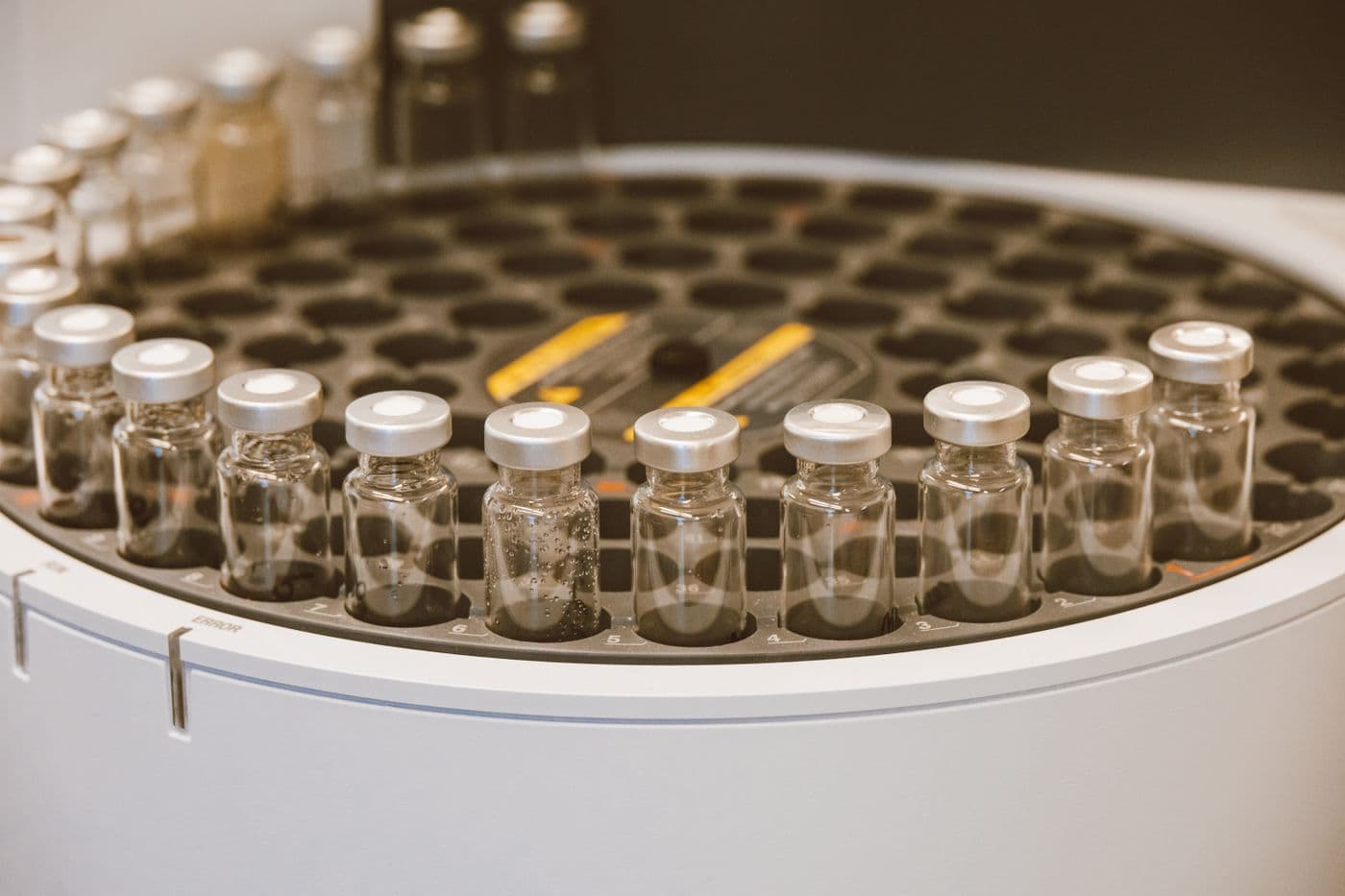
A peptide arrives as a dry cake because dry is the state in which it keeps. That is the whole of the reasoning, and everything downstream of it — which water goes in, how it goes in, what temperature the vial is held at afterwards, what is written on the label — follows from a single asymmetry: a peptide in the solid state degrades slowly, and the same peptide in solution degrades faster. Reconstitution is the moment the material crosses from the first state into the second, and the crossing is one-way.
What follows is a handling account. Why the powder is dry, which water is which, how the solvent should meet the cake, what the concentration arithmetic actually is, and how a prepared vial is stored and labelled afterwards. None of it is a use protocol. Concentration is chemistry — a mass divided by a volume — and it belongs on this page. What anyone does with a prepared solution afterwards does not, and no volume per use, schedule or frequency appears here for any compound.
0.9%
Benzyl alcohol in Bacteriostatic Water for Injection, USP
9 mg/mL · added as a bacteriostatic preservative (1)
50 mg/mL
Concentration a 250 mg lyophilised vial reaches in 5 mL of solvent
bivalirudin for injection · 250 ÷ 5 (2)
6
Major chemical reactions reported for peptides and proteins in the solid state
solid-state stability review · published list counted (3)
4
Residue types reported to undergo primary photooxidation
tryptophan, tyrosine, phenylalanine, cysteine/cystine (4)
Why it arrives as a dry cake
Wang, reviewing the development of solid protein pharmaceuticals, states the problem directly: it is the limited physical and chemical stability of proteins that forces them into solid forms to achieve an acceptable shelf life as pharmaceutical products, and the most commonly used method of preparing those solids is lyophilisation, or freeze-drying (5). Manning and colleagues, updating the stability literature a decade later, treat stabilisation in aqueous solution and stabilisation in the dried state as two separate subjects with two separate sections (6). They are not the same problem, and a vial changes which of them it belongs to at the moment water is added.
Dry is not the same as inert. Lai and Topp, reviewing solid-state chemical stability, record six major reactions that proceed in peptides and proteins in the solid state — deamidation, peptide bond cleavage, oxidation, the Maillard reaction, beta-elimination, and dimerisation or aggregation — and list temperature, moisture content, excipients and the physical state of the formulation, amorphous against crystalline, among the factors that govern them (3). Two of those factors sit in the handler's control rather than the manufacturer's: keep it cold and keep it dry. That is what a freezer and a desiccated, stoppered vial are for.
Freeze-drying is not free either. Wang notes that the lyophilisation process generates both freezing and drying stresses, which can denature proteins to various degrees (5). That is a manufacturing problem rather than a handling one, but it is worth knowing, because it explains why a finished cake is a formulated object rather than simply a peptide with the water taken out.
The clearest published statement of the asymmetry sits on the label of a licensed medicine. Bivalirudin is a twenty-residue synthetic peptide supplied as a lyophilised powder. Its prescribing information directs that the dry dosage units be stored at 20 °C to 25 °C, with excursions permitted between 15 °C and 30 °C, that reconstituted material may be stored at 2 to 8 °C for up to 24 hours, and that reconstituted or diluted material must not be frozen (2). Same molecule, same glass: the dry vial sits at controlled room temperature, and the solution is refrigerated and given a limit stated in hours. That label is quoted here as a documented example of how one manufacturer treats the two states differently. It is not a specification for anything in this catalogue, whose own recorded condition for an unopened vial is −20 °C rather than room temperature.
Bacteriostatic water and sterile water
Neither is chosen for the peptide's sake — both are water for injection, and the peptide cannot tell them apart at the moment it dissolves. The choice is about what happens to the vial after it is first entered. The two labels quoted below are the manufacturers' own prescribing information. They were written for licensed medicines rather than for research material, and they are cited here for what each states about the water itself.
| Parameter | Bacteriostatic Water for Injection, USP | Sterile Water for Injection, USP |
|---|---|---|
| What is dissolved in the water | Benzyl alcohol, added as a bacteriostatic preservative. The label describes presentations containing either 0.9% (9 mg/mL) or 1.1% (11 mg/mL) (1) | Nothing. The label states that it contains no bacteriostat, antimicrobial agent or added buffer (7) |
| How it is supplied | A multiple-dose container from which repeated withdrawals may be made to dilute or dissolve drugs for injection (1) | Supplied only in single dose containers (7) |
| What the label says it is for | Parenteral use only after addition of drugs that require dilution or must be dissolved in an aqueous vehicle prior to injection (1) | Parenteral use only after addition to drugs that require dilution or must be dissolved in an aqueous vehicle prior to injection (7) |
| Which vial it suits | One that will be entered more than once — repeated withdrawal is the use the preservative exists to make possible (1) | One prepared and finished in a single sitting, with nothing left in the glass to protect (7) |
| What it adds to the solution | A second substance. At 0.9% there are 9 mg of benzyl alcohol in every millilitre of the prepared solution, and it does not leave when the cake dissolves (1) | Nothing beyond the water itself (7) |
| The condition recorded for this catalogue | Bacteriostatic water where the vial will be drawn from more than once | Sterile water where it will not |
Sources. (1) Bacteriostatic Water for Injection, USP — prescribing information, Hospira, Inc. DailyMed SetID 87d6e9dc-fe3b-4593-ac9a-d7493d1959c7. (2) Bivalirudin for Injection — prescribing information, Accord Healthcare, Inc. DailyMed SetID c20969cb-72d4-469b-9bd8-332250d896c3. (3) Lai MC, Topp EM. Solid-state chemical stability of proteins and peptides. J Pharm Sci. 1999;88(5):489–500. (4) Kerwin BA, Remmele RL Jr. Protect from light: photodegradation and protein biologics. J Pharm Sci. 2007;96(6):1468–1479. (5) Wang W. Lyophilization and development of solid protein pharmaceuticals. Int J Pharm. 2000;203(1–2):1–60. (6) Manning MC, Chou DK, Murphy BM, Payne RW, Katayama DS. Stability of protein pharmaceuticals: an update. Pharm Res. 2010;27(4):544–575. (7) Sterile Water for Injection, USP — prescribing information, Fresenius Kabi USA, LLC. DailyMed SetID e71c6c83-d518-496c-b2ab-efd5987e4783. (8) Kiese S, Papppenberger A, Friess W, Mahler HC. Shaken, not stirred: mechanical stress testing of an IgG1 antibody. J Pharm Sci. 2008;97(10):4347–4366. (9) Kueltzo LA, Wang W, Randolph TW, Carpenter JF. Effects of solution conditions, processing parameters, and container materials on aggregation of a monoclonal antibody during freeze-thawing. J Pharm Sci. 2008;97(5):1801–1812. Sources (1), (2) and (7) are the prescribing information of licensed medicines, quoted for what each label states about the material it describes; nothing in this catalogue is a licensed medicine.
Down the wall, then swirl
A lyophilised cake is a fragile, highly porous solid with a great deal of surface area, and the solvent's first contact with it is the roughest treatment it will ever receive. A stream directed onto the cake breaks it apart and throws material up the walls of the vial, where some of it stays. A stream directed slowly down the inner wall pools underneath and dissolves the cake from below. The two take the same minute and cost the same nothing.
Once the solvent is in, the vial is swirled rather than shaken. The mechanical-stress literature is written mostly about antibodies rather than short synthetic peptides, and the study cited here is exactly that: Kiese and colleagues stressed an IgG1 antibody in one formulation and found that shaking and stirring produced different aggregate species, both qualitatively and quantitatively, with stirring the more stressful of the two, and that the headspace in the vials had a great influence on the stability of the formulation under shaking (8). That is a measurement on one antibody in one formulation, not a measurement on anything in this catalogue, and it is not evidence about how any particular peptide behaves. What it supports is narrower and worth keeping: agitation is a variable that changes the outcome, headspace is part of that variable, and a foaming vial is one in which air and liquid have been driven together across a large interface. Swirling until the solution runs clear reaches the same endpoint without any of it.
A cake that has not gone into solution after a couple of minutes of gentle swirling is telling you something, and so is a solution that turns cloudy or throws a visible particle. Neither is fixed by shaking harder.
The concentration arithmetic
- Concentration (mg/mL) = peptide mass in the vial (mg) ÷ solvent volume added (mL).
- A 5 mg vial with 1 mL of solvent gives 5 mg/mL. The same vial with 2 mL gives 2.5 mg/mL.
- A 10 mg vial with 2 mL of solvent also gives 5 mg/mL — the same concentration from twice the mass.
- 1 mg/mL is 1,000 micrograms per mL. Convert once, at the start, and hold one unit for the whole calculation.
- Volume (mL) = mass required (mg) ÷ concentration (mg/mL). This is the first line rearranged rather than a second formula to remember.
- A mark on a U-100 insulin barrel is 1/100 mL. The mass behind one mark is therefore the concentration in micrograms per mL ÷ 100 — at 5 mg/mL, which is 5,000 mcg/mL, that is 50 mcg.
- A U-40 barrel puts 40 marks in the same millilitre. Reading a volume off the wrong barrel is out by 100 ÷ 40 = 2.5, which is the most common arithmetic error in this entire sequence.
- A mark on an insulin barrel is a volume, not an International Unit. An IU measures activity and is defined separately for each substance; the two are different quantities and the numbers do not coincide.
A vial with no volume written on it has no known concentration
The mass in the vial is fixed at manufacture and printed on the label. The solvent volume is the only free variable in the equation above, and it is the one nobody records. A vial reconstituted without the volume being written down is not a vial of unknown strength that can be worked out later — the information required to work it out has ceased to exist. Two vials sitting side by side at 2–8 °C, identical in every visible respect, can hold concentrations that differ by a factor of three, and nothing about the glass will say which is which.
So the label goes on before the vial goes anywhere: the date, the solvent used, and the exact volume added. Not the volume intended — the volume that actually went in. Confirm the vial's usable capacity first, since a 2 mL vial will not take 3 mL, and lyophilised vials of this kind are generally filled to take roughly 2 to 3 mL.
For the arithmetic itself, Peptio publishes a reconstitution calculator at /calculator. Given the mass in the vial and the solvent volume it returns the concentration in both mg/mL and mcg/mL, the mass sitting behind one mark on whichever barrel is selected, and the volume corresponding to a given mass. It carries a U-40 barrel alongside the U-100 ones for the reason set out above, and it flags a draw under two marks — too small to read off a barrel with any confidence — as well as one larger than the barrel holds. The arithmetic runs in the browser and nothing is sent anywhere. It is the same few lines above, and it is worth working through by hand once, because the calculator does not know what volume actually went into the vial. Neither does anyone else, if it is not on the label.
Storage, stage by stage
- Form as supplied
- Lyophilised powder in a sealed, stoppered vial
- Storage before reconstitution
- −20 °C, desiccated and protected from light
- In transit
- Short periods at 2–8 °C are expected; that is what the insulated mailer is for
- Solvent
- Bacteriostatic water where the vial will be drawn from more than once; sterile water where it will not (1) (7)
- Typical reconstitution volume
- 1–3 mL, chosen to give the concentration the work calls for
- Storage after reconstitution
- 2–8 °C, protected from light, in the original stoppered vial
- Light
- Excluded at every stage. Tryptophan, tyrosine, phenylalanine and cysteine or cystine are the residues reported to undergo primary photooxidation, and photodegradation has been reported to change primary, secondary and tertiary structure (4)
- Freezing a prepared solution
- Not the condition recorded here. Freeze-thawing has been reported to induce protein aggregation as its primary route of degradation (9), and one licensed lyophilised peptide's label directs that reconstituted or diluted material must not be frozen (2)
- Once opened
- Record the date on the vial. How long a prepared solution stays usable depends on the solvent and the storage temperature, so the date is the only reliable reference point.
Freeze-thaw, light, and dividing a solution
Kueltzo and colleagues, studying a monoclonal antibody through freeze-thawing, state the outcome plainly: the primary route of degradation induced by freeze-thawing is protein aggregation (9). They varied pH, the presence or absence of potassium chloride, protein concentration, cooling and warming rates, and container type and material, and found that the container mattered — samples in plastic or glass showed minimal aggregate formation, while Teflon and commercial freezing containers produced substantially more (9). The study is an antibody rather than a short synthetic peptide, and the abstract states no number of cycles at which anything happens, which is why no cycle count appears anywhere on this page.
That is the reasoning behind aliquoting as a general laboratory technique. Where a laboratory does hold a solution frozen, it divides the volume into portions first, so that each portion is thawed once rather than the whole being thawed and refrozen repeatedly, and it takes an interest in what those portions are held in. It is worth being exact about what that does and does not license here. The condition recorded for a prepared solution in this catalogue is 2–8 °C, protected from light, in the original stoppered vial — refrigerated, not frozen. The bivalirudin label, for a licensed lyophilised peptide, directs outright that reconstituted or diluted material must not be frozen (2). Aliquoting is a way of reducing thaw cycles where freezing is the storage condition; it is not a reason to freeze a solution whose recorded condition is refrigeration.
Light is the quieter variable. Kerwin and Remmele, reviewing photodegradation in protein biologics, record that the residues in proteins undergoing primary photooxidation include tryptophan, tyrosine, phenylalanine and cysteine or cystine, and that photodegradation can lead to changes in the primary, secondary and tertiary structures of protein (4). Four residue types is not an exotic list — it is most of the aromatic content of an ordinary sequence, plus the residue that forms disulfide bridges. Protection from light is therefore not a precaution reserved for long-term storage: it applies to the sealed vial, to the prepared solution, and to the interval on the bench in between.
One further transition is easy to miss. A vial taken from cold storage is opened after it has reached room temperature, not before. Cold glass in a warm room draws condensation onto and into itself, and moisture content is one of the factors Lai and Topp list as governing solid-state degradation (3). Warming a sealed vial costs a few minutes. Wetting a desiccated cake cannot be undone.
Where handling goes wrong
| Correct | Common mistake |
|---|---|
| Direct the solvent slowly down the inner wall of the vial and let it pool under the cake. | Drive it onto the cake in a fast stream and break the solid apart against the glass. |
| Swirl gently until the solution runs clear, and allow it the minute or two it takes. | Shake or vortex the vial — agitation and headspace are variables that change what comes out of it (8). |
| Let a vial from cold storage reach room temperature while it is still sealed. | Open a vial straight out of the freezer and pull condensation into a solid that is kept dry on purpose (3). |
| Choose bacteriostatic water where the vial will be entered more than once, and sterile water where it will not (1) (7). | Treat the two as interchangeable — one is a multiple-dose container carrying a preservative, the other is supplied only in single dose containers (1) (7). |
| Write the date, the solvent and the exact volume added on the vial before it is put away. | Rely on memory; a prepared vial with no recorded volume has no recoverable concentration. |
| Confirm the vial's usable capacity before adding anything to it. | Assume the vial will take whatever volume the arithmetic asked for — a 2 mL vial will not hold 3 mL. |
| Keep the prepared solution refrigerated and shielded from light between uses (4). | Leave a reconstituted vial standing on the bench in daylight, or freeze one whose recorded condition is 2–8 °C (2) (9). |
| Look at the solution before every use and confirm that it is still clear. | Use a solution that has turned cloudy or thrown a visible particle. |
Research use only
Peptio is not a pharmacy, and everything in this catalogue is supplied for research use only — not for human or veterinary consumption. This page is about handling a vial: which solvent, how it goes in, what the resulting concentration is, and how the material is stored and labelled. It is not a protocol for administering anything to anyone, and no volume per use, schedule or frequency appears on it for any compound. The prescribing information quoted above belongs to licensed medicines and is cited for what each label states about its own material; none of it is a specification for anything sold here.