In stockBestseller
For research use only · Not for human consumption
218
Adults randomised in the Phase 3 myopathy trial
MMPOWER-3 · 109 elamipretide · 109 placebo (1)
−3.2 m
Six-minute walk test, difference from placebo
40 mg/day · week 24 · p = 0.69 · endpoint not met (1)
−0.07
Total fatigue score, difference from placebo
PMMSA · week 24 · p = 0.37 · endpoint not met (1)
4
Amino acid residues
D-Arg · Dmt · Lys · Phe (8)
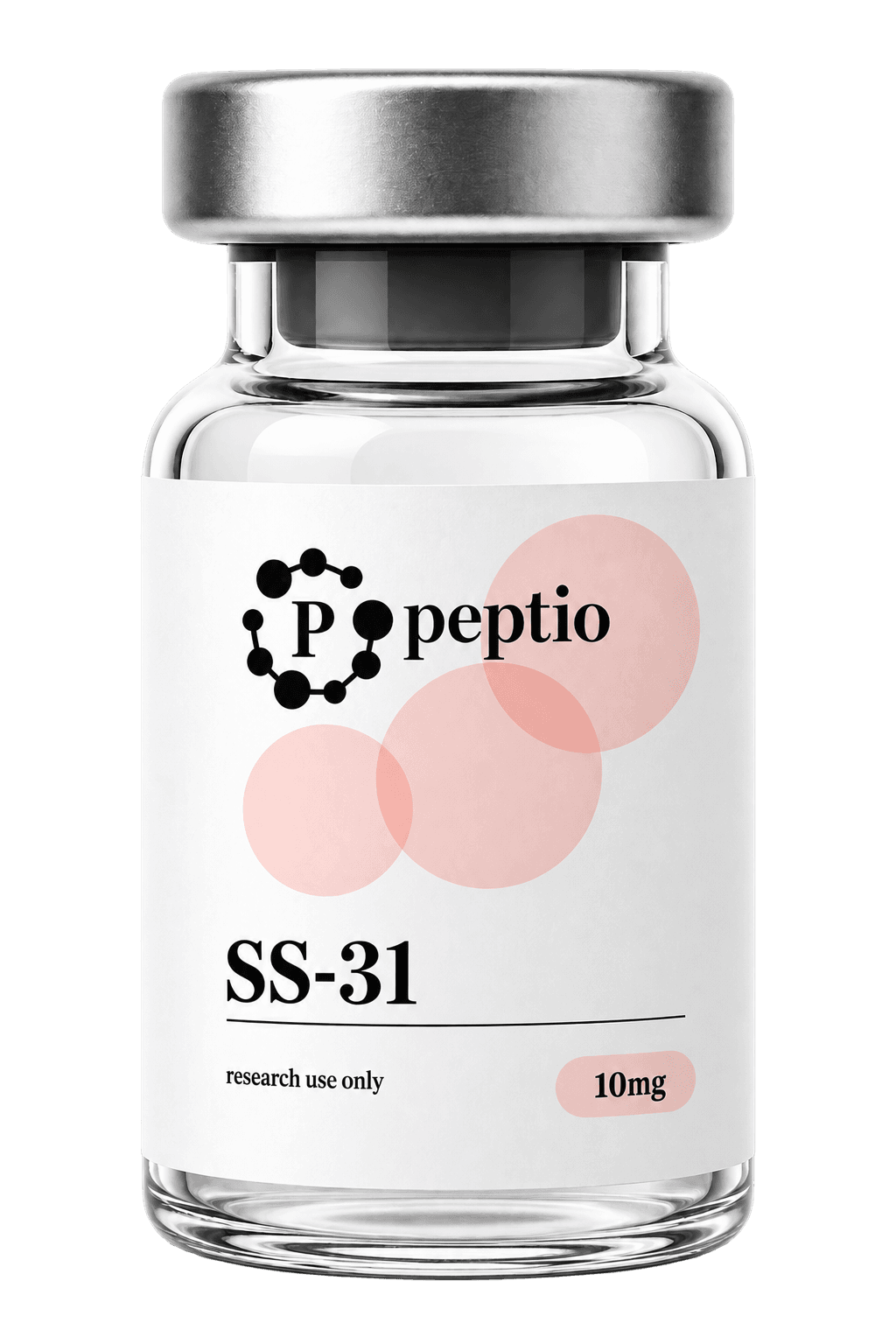
SS-31 is a synthetic tetrapeptide developed by Stealth BioTherapeutics, which carried it through clinical development as elamipretide and, earlier, under the code MTP-131. Four residues — D-Arg, dimethyltyrosine, Lys and Phe — alternate cationic and aromatic side chains, and that alternation is the design (8).
What separates it from most peptides in this catalogue is what it binds. Birk and colleagues, using a polarity-sensitive fluorescent analogue of the peptide, reported high-affinity binding to cardiolipin — an anionic phospholipid of the inner mitochondrial membrane that cristae formation requires (9). The target is a lipid rather than a receptor, and the work cited on this page describes no receptor for it.
It is also the most clinically tested compound in this catalogue outside the incretin peptides. Elamipretide reached Phase 3 in primary mitochondrial myopathy and was tested in randomised, placebo-controlled trials in Barth syndrome and in dry age-related macular degeneration. Those trials are why this page can report outcomes rather than mechanisms alone, and the outcome, in the main, is that the primary endpoints were not met.
In September 2025 the US Food and Drug Administration granted elamipretide hydrochloride accelerated approval under the name FORZINITY, for one rare indication only (7). That approval is narrow, it is conditional, and it does not describe the material on this page. A section further down sets out exactly what it covers.
CL
Cardiolipin, not a receptor
Birk and colleagues used a polarity-sensitive fluorescent analogue of SS-31 to demonstrate high-affinity binding to cardiolipin, the anionic phospholipid of the inner mitochondrial membrane that is required for cristae formation (9). A later structural review describes the same localisation and attributes the binding to electrostatic interaction with the peptide's positively charged residues (8).
SEQ
Alternating charge and aromatic rings
The sequence is D-Arg-Dmt-Lys-Phe-NH2: two cationic residues and two aromatic ones. The review attributes the peptide's cell permeability, despite a net positive charge, to charge shielding by electrons in the π orbitals of the phenylalanine and dimethyltyrosine rings (8).
ETC
Cristae and the electron transport chain
In the 2013 work the SS-31 and cardiolipin complex inhibited cytochrome c peroxidase activity by protecting its heme iron, and pretreatment of rats protected cristae membranes during renal ischaemia and prevented mitochondrial swelling (9). The review reports improved assembly and activity of complexes I, III and IV (8).
ROS
What was measured downstream
Reduced reactive oxygen species production, preserved ATP production, and prevention of cytochrome c release with the caspase-dependent apoptosis that follows it (8). These are measurements in cell and animal models. They are not the outcomes measured in the human trials described below, and those trials did not confirm them as clinical benefit.
MMPOWER-3 was a randomised, double-blind, placebo-controlled Phase 3 trial in adults with genetically confirmed primary mitochondrial myopathy. It randomised 218 participants one to one — 109 to elamipretide at 40 mg a day subcutaneously and 109 to placebo — for 24 weeks. Mean age was 45.6 years, 64% of participants were women, and the mean distance walked on the six-minute walk test at baseline was 336.7 ± 81.2 metres (1).
It had two primary endpoints and missed both. On the six-minute walk test at week 24 the difference between arms was −3.2 metres (95% CI −18.7 to 12.3; p = 0.69): the elamipretide arm gained a least-squares mean of 14.1 metres and the placebo arm gained 17.3. On the Primary Mitochondrial Myopathy Symptom Assessment total fatigue score the difference was −0.07 (p = 0.37), from −1.13 on elamipretide against −1.05 on placebo. The authors' own conclusion is that subcutaneous elamipretide did not improve either outcome, and that it was well tolerated (1).
One post hoc analysis is the reason the programme continued. Among participants whose disease came from nuclear rather than mitochondrial DNA — 29 per arm, out of 218 — six-minute walk distance at week 24 rose by a least-squares mean of 25.5 metres on elamipretide against 0.3 metres on placebo, a difference of 25.2 metres (95% CI 3.1–47.3; p = 0.03) (1). A later genotype analysis narrowed that to participants with variants in the genes that maintain mitochondrial DNA, where the same measure read 25.2 metres against 2.0 on placebo at p = 0.06 (2). Both are post hoc, in a trial that was negative overall, and the second paper presents them as the foundation for a further trial rather than as a finding.
MMPOWER-3 missed both of its primary endpoints, and this is the first of them. The upper bar is the whole randomised population, where the placebo arm walked further at week 24 than the elamipretide arm did. The lower bar is a post hoc subgroup — 29 participants per arm, out of 218 — which the authors report as an observation to be tested rather than as a result.
Elamipretide 40 mg/day all participants, n = 109
14.1 m
Elamipretide 40 mg/day nuclear DNA subgroup, post hoc, n = 29
25.5 m
Sources. (1) Karaa A, Bertini E, Carelli V, et al. Efficacy and Safety of Elamipretide in Individuals With Primary Mitochondrial Myopathy: The MMPOWER-3 Randomized Clinical Trial. Neurology. 2023;101(3):e238–e252. Figures are the least-squares mean change from baseline in distance walked at week 24. The trial did not meet either primary endpoint: the between-group difference was −3.2 m (95% CI −18.7 to 12.3; p = 0.69) on the six-minute walk test and −0.07 (p = 0.37) on the PMMSA total fatigue score. The nuclear DNA analysis is described in that paper as post hoc. Elamipretide holds no marketing authorisation outside a single US accelerated approval in Barth syndrome, and none in the EU.
SS-31 and NAD+ are both studied in mitochondrial research, and that is close to all they share. One is a synthetic peptide that binds a membrane lipid; the other is a coenzyme the cell makes and consumes. No trial has compared them, and no row below is a numeric comparison — the columns describe what each compound is, what the cited work says it acts on, and how far each has been taken in people.
| Parameter | SS-31 | NAD+ |
|---|---|---|
| Molecular class | Synthetic tetrapeptide, D-Arg-Dmt-Lys-Phe-NH2 (8) | Dinucleotide coenzyme, not a peptide (10) |
| Where the cited work places it | Concentrated at the inner mitochondrial membrane (8, 9) | Throughout the cell — as a redox cofactor, and in signalling, epigenetic regulation and energy homeostasis (10) |
| What it acts on | Cardiolipin, an anionic phospholipid — a lipid rather than a receptor (9) | Enzymes, as cofactor or consumed co-substrate rather than as a ligand at a receptor (10) |
| Furthest stage reached in people | Phase 3, completed and published — MMPOWER-3, 218 adults (1). A second Phase 3 is recorded as completed (6) | The cited review summarises trials of the precursors — nicotinic acid, nicotinamide, nicotinamide riboside, nicotinamide mononucleotide — rather than of NAD+ itself (10) |
| What the largest cited trial reported | Both primary endpoints missed: −3.2 m on the six-minute walk test (p = 0.69) and −0.07 on total fatigue (p = 0.37), at week 24 (1) | No single trial is cited; the review calls for further large-scale studies to settle dose, route, frequency and long-term safety (10) |
| Administration in the cited work | Subcutaneous injection, once daily, in every trial reported on this page (1, 3, 5) | The review records that optimal dose, administration route and frequency remain to be determined (10) |
| Approval status | One US accelerated approval, in Barth syndrome only, since 19 September 2025 (7). No authorisation for any other indication, and no EMA-approved therapy for that indication exists | No marketing authorisation as a medicine. Peptio supplies it for research use only |
Sources. (1) Karaa A, Bertini E, Carelli V, et al. Efficacy and Safety of Elamipretide in Individuals With Primary Mitochondrial Myopathy: The MMPOWER-3 Randomized Clinical Trial. Neurology. 2023;101(3):e238–e252. (2) Karaa A, Bertini E, Carelli V, et al. Genotype-specific effects of elamipretide in patients with primary mitochondrial myopathy: a post hoc analysis of the MMPOWER-3 trial. Orphanet J Rare Dis. 2024;19(1):431. (3) Reid Thompson W, Hornby B, Manuel R, et al. A phase 2/3 randomized clinical trial followed by an open-label extension to evaluate the effectiveness of elamipretide in Barth syndrome, a genetic disorder of mitochondrial cardiolipin metabolism. Genet Med. 2021;23(3):471–478. (4) Thompson WR, Manuel R, Abbruscato A, et al. Long-term efficacy and safety of elamipretide in patients with Barth syndrome: 168-week open-label extension results of TAZPOWER. Genet Med. 2024;26(7):101138. (5) Ehlers JP, Hu A, Boyer D, et al. ReCLAIM-2: A Randomized Phase II Clinical Trial Evaluating Elamipretide in Age-related Macular Degeneration, Geographic Atrophy Growth, Visual Function, and Ellipsoid Zone Preservation. Ophthalmol Sci. 2025;5(1):100628. (6) ClinicalTrials.gov. NuPower, NCT05162768. Sponsor: Stealth BioTherapeutics Inc. Registry record; status completed, 102 participants enrolled. (7) Stealth BioTherapeutics. FDA accelerated approval of FORZINITY (elamipretide HCl) in Barth syndrome, 19 September 2025. NDA 215244. (8) Tung C, Varzideh F, Farroni E, et al. Elamipretide: A Review of Its Structure, Mechanism of Action, and Therapeutic Potential. Int J Mol Sci. 2025;26(3):944. (9) Birk AV, Liu S, Soong Y, et al. The mitochondrial-targeted compound SS-31 re-energizes ischemic mitochondria by interacting with cardiolipin. J Am Soc Nephrol. 2013;24(8):1250–1261. (10) Zhang J, Wang HL, Lautrup S, et al. Emerging strategies, applications and challenges of targeting NAD+ in the clinic. Nat Aging. 2025;5(9):1704–1731. SS-31 is supplied here as a research compound and is not the approved product named above.
On 19 September 2025 the FDA granted elamipretide hydrochloride accelerated approval under the name FORZINITY, indicated to improve muscle strength in adult and paediatric patients with Barth syndrome weighing at least 30 kg (7). Barth syndrome is a genetic disorder of cardiolipin metabolism, which is why it was the indication where a cardiolipin-binding peptide had the clearest case to make.
Three things about that approval are worth stating plainly. It is accelerated — granted on knee extensor muscle strength as an intermediate clinical endpoint rather than on a clinical outcome, with continued approval potentially contingent on a confirmatory trial. It is American: the same announcement records that no EMA-approved therapy exists for Barth syndrome (7). And it is confined to that one indication. The Phase 3 trial in primary mitochondrial myopathy and the Phase 2 trial in dry age-related macular degeneration both missed their primary endpoints, and neither supports an authorisation (1, 5).
None of it describes what is on this page. An approved medicine is a specific product, made to a licensed specification and prescribed for a named condition. SS-31 supplied as a research compound is not that product, is not prescribed and is not a medicine, and the approval above changes nothing about what may be done with this vial.
A sealed vial of lyophilised powder, in a 10 mg or a 20 mg size. Both are the same material; the difference is the mass in the vial, not the concentration — concentration is set later, by how much solvent is added.
Each batch is released against a certificate of analysis from an independent issuer, and the batch number printed on the vial matches the number on that certificate. Checking those two against each other is the most useful thing to do with a delivery. The purity, form, storage condition and molecular weight recorded for the current batch are in the specifications above.
Handling is the same as for every other compound in the catalogue. The handling protocol below covers storage temperatures, solvent choice and the concentration calculation.
Research use only
SS-31 is supplied here as a research compound, not as a medicine. Elamipretide holds a single accelerated approval, in the United States and in Barth syndrome alone, under a brand name and a licensed specification that have nothing to do with this vial; it holds no authorisation for any other indication. Peptio is not a pharmacy and supplies this material for research use only — not for human or veterinary consumption. Everything reported on this page comes from published trials and describes their participants; none of it is guidance for use in people.
Every compound Peptio ships arrives as a sealed vial of lyophilised powder. Freeze-drying is what keeps it stable in transit: with the water removed and the vial closed, the peptide keeps far longer than it would in solution. The protocol below applies to all of them, and it is the same protocol whichever compound is in the vial.
The steps that matter most happen in the first few minutes after a vial is opened, and in how the prepared solution is labelled afterwards. A vial with no recorded solvent volume is a vial with no known concentration, and no amount of care later recovers that.
01
Inspect on arrival
Check that the crimp seal and stopper are intact and that the powder cake is dry and unbroken. Compare the batch number printed on the vial with the number on the certificate of analysis. A cake that has slumped into a film, or a vial that arrives loose in its packaging, is worth photographing before anything else is done to it.
02
Equilibrate before opening
Let a vial taken from cold storage stand sealed until it reaches room temperature. Opening cold glass in a warm room pulls condensation onto it, and moisture is the one thing a desiccated powder is being protected from.
03
Add the solvent
Direct the solvent slowly down the inner wall of the vial rather than onto the cake, then let it dissolve on its own and swirl gently until the solution runs clear. This takes a minute or two, and it is not helped by shaking.
04
Label, then refrigerate
Write the date, the solvent and the exact volume added onto the vial before it goes anywhere. Keep the prepared solution cold and out of direct light, and check that it is still clear each time it is used.
| Correct | Common mistake |
|---|---|
| Direct the solvent down the inner wall of the vial and let the cake dissolve on its own. | Drive the solvent onto the powder in a fast stream. |
| Swirl gently until the solution runs clear. | Shake or vortex the vial — mechanical agitation and foaming degrade peptide structure. |
| Let a vial from cold storage reach room temperature while it is still sealed. | Open a vial straight out of the freezer, and pull condensation into a product that is kept dry on purpose. |
| Label every prepared vial with the date, the solvent and the volume added. | Rely on memory — two vials that look identical at 2–8 °C can hold two different concentrations. |
| Draw through the stopper with a fresh sterile needle each time. | Prise off the crimp seal; an open vial cannot be kept sterile. |
| Keep prepared solution cold and shielded from light between uses. | Leave a reconstituted vial standing at room temperature on the bench. |
| Look at the solution before every use and confirm it is clear. | Use a solution that has turned cloudy or thrown a visible particle. |
Solvent volume sets the concentration
The mass of peptide in a vial is fixed at manufacture. The only variable is how much solvent goes in, and it changes every measurement that follows — 2 mL instead of 1 mL halves the concentration. Confirm the vial's usable capacity before adding anything, since a 2 mL vial will not take 3 mL, and write down the volume you actually added.
Questions
0.0
0 reviews
No reviews yet.