In stockBestseller
For research use only · Not for human consumption
−14.9%
Mean weight change at 68 weeks
2.4 mg · 68 weeks · placebo −2.4% (1)
50.5%
Reached a weight reduction of 15% or more
2.4 mg · 68 weeks · placebo 4.9% (1)
−1.86
HbA1c points, type 2 diabetes
1 mg · 40 weeks · 1,879 adults (2)
0.80
Hazard ratio, major cardiovascular events
2.4 mg · 17,604 adults · 95% CI 0.72–0.90 (3)
Semaglutide is a synthetic analogue of human glucagon-like peptide-1, developed by Novo Nordisk. It acts at one receptor — GLP-1 — and what separates it from the peptide it is modelled on is not what it binds but how long it stays in circulation.
Lau and colleagues described the design work in the Journal of Medicinal Chemistry in 2015. The stated aim was a once-weekly GLP-1 analogue, reached by increasing affinity for serum albumin and securing full stability against metabolic degradation; semaglutide was selected as the optimal once-weekly candidate. It carries two amino-acid substitutions relative to human GLP-1, at positions 8 and 34, and is derivatised at lysine 26 (4).
That work records the trade the design made. The reported GLP-1 receptor affinity of semaglutide was 0.38 nM, three-fold decreased compared with liraglutide, while affinity for albumin increased — potency at the receptor given up for time in circulation. The plasma half-life reported in mini-pigs after intravenous administration was 46.1 hours (4).
Semaglutide is not an investigational compound. The active substance is authorised as a prescription medicine in the European Union, and it has been studied in Phase 3 trials enrolling thousands of adults. None of that describes the vial on this page: Peptio is not a pharmacy, what it supplies is not a licensed medicinal product, and every figure below describes what happened to participants in a published trial rather than a protocol for anyone to follow.
Aib8
Substitution at position 8
Lau and colleagues report two amino-acid substitutions relative to human GLP-1, and this is the first of them. The stated aim of that work was a once-weekly analogue with full stability against metabolic degradation (4).
Arg34
Substitution at position 34
The second of the two substitutions reported in the same work. Together with the derivatisation described alongside, it is the whole of what the paper records as separating semaglutide's sequence from human GLP-1 (4).
Lys26
The acylation site
Semaglutide is derivatised at lysine 26. Lau and colleagues name the fatty acid moiety and the linking chemistry as the key features securing high albumin affinity together with GLP-1 receptor potency, and report a receptor affinity of 0.38 nM against increased albumin affinity (4).
One trial, 1,961 adults without diabetes, 68 weeks. Every bar here comes from the same trial, so they are directly comparable to each other. Each bar is the proportion of the 2.4 mg group that reached that threshold, and the figure drawn beneath it is the proportion of the placebo group in the same trial.
5% or more 2.4 mg, 68 wks
86.4%
10% or more 2.4 mg, 68 wks
69.1%
15% or more 2.4 mg, 68 wks
50.5%
Sources. (1) Wilding JPH, Batterham RL, Calanna S, et al. Once-Weekly Semaglutide in Adults with Overweight or Obesity. N Engl J Med. 2021;384(11):989–1002. Figures are the proportion of participants in each group whose body weight fell by at least the stated amount at 68 weeks. Semaglutide is authorised as a prescription medicine in the European Union under other brand names; what Peptio supplies is not that licensed product and is for research use only.
STEP 1 randomised 1,961 adults with a body-mass index of 30 or greater — 27 or greater with a weight-related coexisting condition — and without diabetes, in a 2:1 ratio to 2.4 mg once weekly or placebo for 68 weeks. The mean change in body weight was −14.9% against −2.4% on placebo, an estimated treatment difference of −12.4 percentage points, or −15.3 kg against −2.6 kg (1).
STEP 2 ran the same dose for the same 68 weeks in 1,210 adults who also had type 2 diabetes, and reported an estimated mean change of −9.6% against −3.4% on placebo — a smaller figure, in a different population, from a different trial (5). STEP 4 asked a different question again: after a 20-week run-in, 803 of 902 participants who had reached the 2.4 mg maintenance dose were randomised to continue or to switch to placebo for 48 weeks. From week 20 to week 68 the continuing group changed by −7.9%, while the group switched to placebo gained 6.9% (6).
Outside the weight programme, SELECT enrolled 17,604 adults aged 45 or over with pre-existing cardiovascular disease and no history of diabetes, and randomised them 1:1 to 2.4 mg once weekly or placebo. Over a mean follow-up of 39.8 months, a primary end-point event — cardiovascular death, non-fatal myocardial infarction or non-fatal stroke — occurred in 6.5% of the semaglutide group against 8.0% on placebo, a hazard ratio of 0.80 with a 95% confidence interval of 0.72 to 0.90 (3).
Each bar comes from a different trial, and the trials differ in phase, length, population and design — so these are not head-to-head results. Each placebo arm is the one from that bar's own trial. Semaglutide is drawn first because this is its page, not because it is the largest figure.
Semaglutide 2.4 mg, 68 wks
−14.9%
Tirzepatide 15 mg, 72 wks
−20.9%
Retatrutide 12 mg, 48 wks
−24.2%
Sources. (1) Wilding JPH, Batterham RL, Calanna S, et al. Once-Weekly Semaglutide in Adults with Overweight or Obesity. N Engl J Med. 2021;384(11):989–1002. (7) Jastreboff AM, Aronne LJ, Ahmad NN, et al. Tirzepatide Once Weekly for the Treatment of Obesity. N Engl J Med. 2022;387(3):205–216. (8) Jastreboff AM, Kaplan LM, Frías JP, et al. Triple-Hormone-Receptor Agonist Retatrutide for Obesity — A Phase 2 Trial. N Engl J Med. 2023;389(6):514–526. Semaglutide and tirzepatide are authorised as prescription medicines in the European Union; retatrutide is investigational and holds no marketing authorisation. What Peptio supplies is research material rather than a licensed medicine.
Each column reports figures from a different published trial, and the trials differ in phase, length, population and design — so the columns are not a head-to-head comparison. The one exception is the HbA1c row: the Semaglutide and Tirzepatide figures there come from the same trial, in which the two were compared directly.
| Parameter | Semaglutide | Tirzepatide | Retatrutide |
|---|---|---|---|
| Receptor targets | GLP-1 | GLP-1 and GIP | GLP-1, GIP and glucagon |
| Weight trial cited here | STEP 1, Phase 3, 1,961 adults, 68 weeks (1) | SURMOUNT-1, Phase 3, 2,539 adults, 72 weeks (7) | Phase 2, 338 adults, 48 weeks (8) |
| Largest mean weight change reported | −14.9% (2.4 mg) | −20.9% (15 mg) | −24.2% (12 mg) |
| Placebo arm in the same trial | −2.4% | −3.1% | −2.1% |
| HbA1c change in type 2 diabetes | −1.86 points at 40 weeks, 1 mg (2) | −2.30 points at 40 weeks, 15 mg (2) | −2.02 points at 24 weeks, 12 mg (Phase 2, 281 adults) (9) |
| Administration in the cited trials | Once weekly, subcutaneous | Once weekly, subcutaneous | Once weekly, subcutaneous |
| Regulatory status | Authorised in the EU — Ozempic (2018), Wegovy (2022) | Authorised in the EU — Mounjaro (2022) | Investigational; no marketing authorisation |
Sources. (1) Wilding JPH, Batterham RL, Calanna S, et al. Once-Weekly Semaglutide in Adults with Overweight or Obesity. N Engl J Med. 2021;384(11):989–1002. (2) Frías JP, Davies MJ, Rosenstock J, et al. Tirzepatide versus Semaglutide Once Weekly in Patients with Type 2 Diabetes. N Engl J Med. 2021;385(6):503–515. (7) Jastreboff AM, Aronne LJ, Ahmad NN, et al. Tirzepatide Once Weekly for the Treatment of Obesity. N Engl J Med. 2022;387(3):205–216. (8) Jastreboff AM, Kaplan LM, Frías JP, et al. Triple-Hormone-Receptor Agonist Retatrutide for Obesity — A Phase 2 Trial. N Engl J Med. 2023;389(6):514–526. (9) Rosenstock J, Frias J, Jastreboff AM, et al. Retatrutide, a GIP, GLP-1 and glucagon receptor agonist, for people with type 2 diabetes: a randomised, double-blind, placebo and active-controlled, parallel-group, phase 2 trial conducted in the USA. Lancet. 2023;402(10401):529–544. Regulatory status is taken from the European Medicines Agency's public medicine pages for Ozempic, Wegovy and Mounjaro. Cited elsewhere on this page: (3) Lincoff AM, Brown-Frandsen K, Colhoun HM, et al. Semaglutide and Cardiovascular Outcomes in Obesity without Diabetes. N Engl J Med. 2023;389(24):2221–2232. (4) Lau J, Bloch P, Schäffer L, et al. Discovery of the Once-Weekly Glucagon-Like Peptide-1 (GLP-1) Analogue Semaglutide. J Med Chem. 2015;58(18):7370–7380. (5) Davies M, Færch L, Jeppesen OK, et al. Semaglutide 2·4 mg once a week in adults with overweight or obesity, and type 2 diabetes (STEP 2): a randomised, double-blind, double-dummy, placebo-controlled, phase 3 trial. Lancet. 2021;397(10278):971–984. (6) Rubino D, Abrahamsson N, Davies M, et al. Effect of Continued Weekly Subcutaneous Semaglutide vs Placebo on Weight Loss Maintenance in Adults With Overweight or Obesity: The STEP 4 Randomized Clinical Trial. JAMA. 2021;325(14):1414–1425.
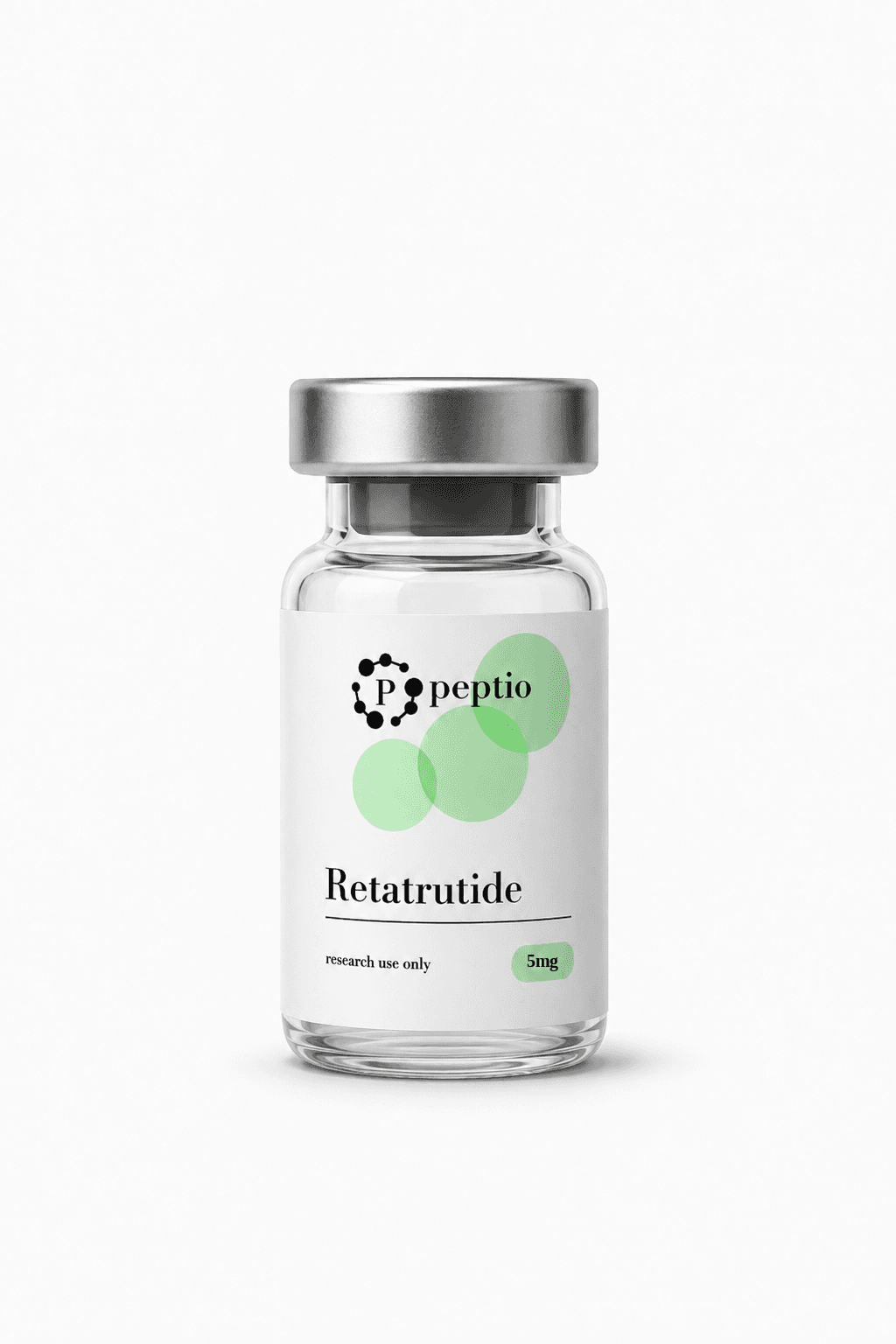
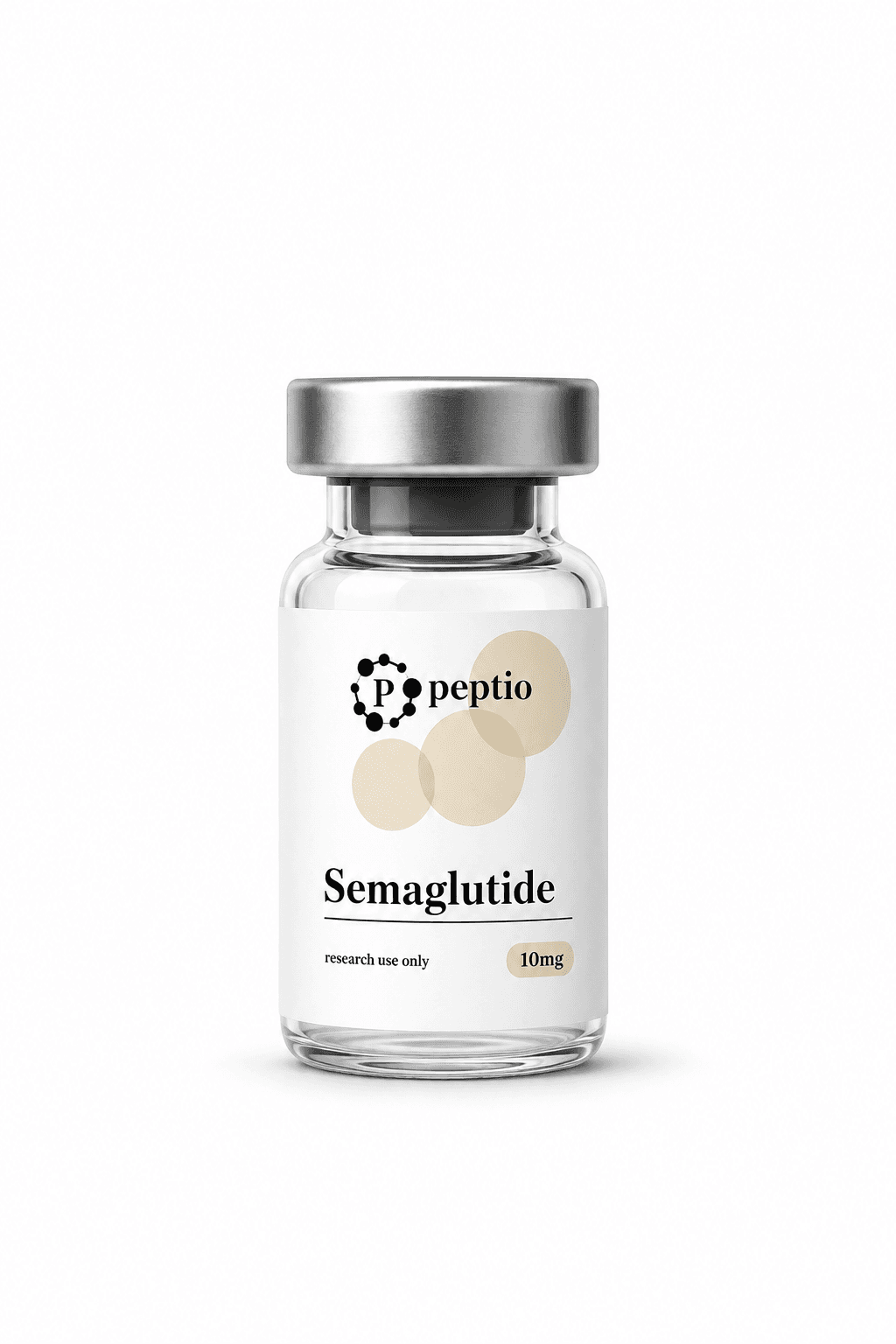
A sealed vial of lyophilised powder, in a 5 mg or a 10 mg size. Both are the same material; the difference is the mass in the vial, not the concentration — concentration is set later, by how much solvent is added.
Each batch is released against a certificate of analysis from an independent issuer, and the batch number printed on the vial matches the number on that certificate. Checking those two against each other is the most useful thing to do with a delivery. The purity, form, storage condition and molecular weight recorded for the current batch are in the specifications above.
Handling is the same as for every other compound in the catalogue. The handling protocol below covers storage temperatures, solvent choice and the concentration calculation.
Research use only
Semaglutide is not investigational: the active substance is authorised as a prescription medicine in the European Union, as Ozempic since 2018 and as Wegovy since 2022. That authorisation belongs to those products, made and released under it, and it does not extend to this vial. Peptio is not a pharmacy, does not dispense medicines, and supplies this material for research use only — not for human or veterinary consumption. Everything reported on this page comes from published trials and describes their participants; none of it is guidance for use in people, and no protocol for use is published here.
Every compound Peptio ships arrives as a sealed vial of lyophilised powder. Freeze-drying is what keeps it stable in transit: with the water removed and the vial closed, the peptide keeps far longer than it would in solution. The protocol below applies to all of them, and it is the same protocol whichever compound is in the vial.
The steps that matter most happen in the first few minutes after a vial is opened, and in how the prepared solution is labelled afterwards. A vial with no recorded solvent volume is a vial with no known concentration, and no amount of care later recovers that.
01
Inspect on arrival
Check that the crimp seal and stopper are intact and that the powder cake is dry and unbroken. Compare the batch number printed on the vial with the number on the certificate of analysis. A cake that has slumped into a film, or a vial that arrives loose in its packaging, is worth photographing before anything else is done to it.
02
Equilibrate before opening
Let a vial taken from cold storage stand sealed until it reaches room temperature. Opening cold glass in a warm room pulls condensation onto it, and moisture is the one thing a desiccated powder is being protected from.
03
Add the solvent
Direct the solvent slowly down the inner wall of the vial rather than onto the cake, then let it dissolve on its own and swirl gently until the solution runs clear. This takes a minute or two, and it is not helped by shaking.
04
Label, then refrigerate
Write the date, the solvent and the exact volume added onto the vial before it goes anywhere. Keep the prepared solution cold and out of direct light, and check that it is still clear each time it is used.
| Correct | Common mistake |
|---|---|
| Direct the solvent down the inner wall of the vial and let the cake dissolve on its own. | Drive the solvent onto the powder in a fast stream. |
| Swirl gently until the solution runs clear. | Shake or vortex the vial — mechanical agitation and foaming degrade peptide structure. |
| Let a vial from cold storage reach room temperature while it is still sealed. | Open a vial straight out of the freezer, and pull condensation into a product that is kept dry on purpose. |
| Label every prepared vial with the date, the solvent and the volume added. | Rely on memory — two vials that look identical at 2–8 °C can hold two different concentrations. |
| Draw through the stopper with a fresh sterile needle each time. | Prise off the crimp seal; an open vial cannot be kept sterile. |
| Keep prepared solution cold and shielded from light between uses. | Leave a reconstituted vial standing at room temperature on the bench. |
| Look at the solution before every use and confirm it is clear. | Use a solution that has turned cloudy or thrown a visible particle. |
Solvent volume sets the concentration
The mass of peptide in a vial is fixed at manufacture. The only variable is how much solvent goes in, and it changes every measurement that follows — 2 mL instead of 1 mL halves the concentration. Confirm the vial's usable capacity before adding anything, since a 2 mL vial will not take 3 mL, and write down the volume you actually added.
Questions
0.0
0 reviews
No reviews yet.