In stockNew
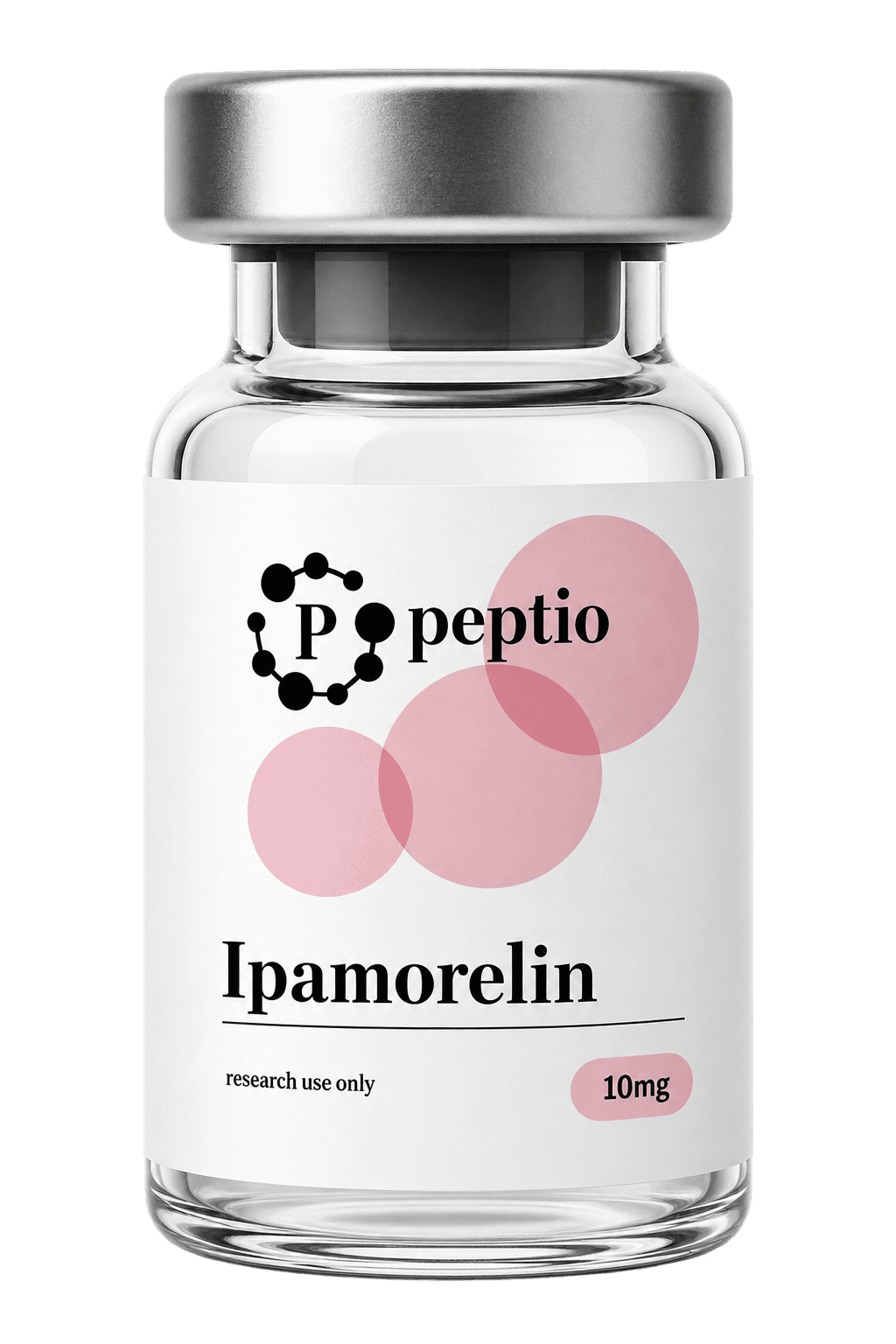
For research use only · Not for human consumption
1.3 nmol/l
Concentration for half-maximal GH release in vitro
rat pituitary cells · GHRP-6 2.2 nmol/l (1)
>200×
Dose multiple giving no rise in ACTH or cortisol
conscious swine · against GHRH stimulation (1)
2 h
Terminal half-life in healthy volunteers
15-minute intravenous infusion · eight men per dose level (2)
25.3 h
Median time to first tolerated meal after bowel surgery
placebo 32.6 h · p = 0.15 · 114 adults (3)
Ipamorelin is a synthetic pentapeptide, Aib-His-D-2-Nal-D-Phe-Lys-NH2, described by Raun and colleagues in the European Journal of Endocrinology in 1998 under the title that has followed it ever since: the first selective growth hormone secretagogue (1).
The word carrying the weight in that title is selective. Compounds that make the pituitary release growth hormone were not new in 1998 — GHRP-6 and GHRP-2 were already characterised — but in the same experiments those two also raised adrenocorticotrophic hormone and cortisol. Ipamorelin did not, at doses more than 200 times its own ED50 for growth hormone release, and that comparison was made in conscious swine (1).
The receptor it acts on was named after those earlier peptides. Later work describes ipamorelin as a selective growth hormone secretagogue and an agonist of the ghrelin receptor (4); the receptor's endogenous ligand, ghrelin, was purified from rat stomach and reported in 1999, the year after ipamorelin was characterised (5).
Ipamorelin remains investigational. It holds no marketing authorisation in any jurisdiction, its one substantial clinical programme was in abdominal surgery rather than endocrinology, and every figure on this page describes an experiment — animal or human — rather than a protocol for anyone to follow.
GH
The hormone that rose
In primary rat pituitary cells ipamorelin released growth hormone with a half-maximal concentration of 1.3 nmol/l against 2.2 nmol/l for GHRP-6. In anaesthetised rats the ED50 was 80 nmol/kg against 115 nmol/kg for GHRP-6, and in conscious swine 2.3 nmol/kg against 3.9 nmol/kg (1).
ACTH
The hormones that did not
In the swine experiments both GHRP-6 and GHRP-2 raised plasma ACTH and cortisol. Ipamorelin raised neither above the levels seen after GHRH stimulation, even at doses more than 200-fold above its ED50 for growth hormone release. That single result is what the paper's title rests on (1).
PRL
The hormones nothing moved
Prolactin, FSH, LH and TSH were unchanged by every secretagogue tested — ipamorelin and the two GHRPs alike. The selectivity reported in that paper is therefore specifically against ACTH and cortisol, it does not extend to prolactin because prolactin never moved, and it was measured in swine rather than in people (1).
It is thin, and most of it is old. A dose-escalation study in healthy male volunteers — eight men per dose level, five 15-minute intravenous infusions from 4.21 to 140.45 nmol/kg — reported a terminal half-life of about 2 hours, a clearance of 0.078 l/h/kg and a modelled concentration for half-maximal growth hormone stimulation of 214 nmol/l (2).
The compound was then taken into surgery. Helsinn Therapeutics developed it for postoperative ileus, on the reasoning that an agonist at the ghrelin receptor might help the gut restart after bowel resection — a use with no bearing on why the compound is catalogued here. A randomised, double-blind, placebo-controlled proof-of-concept trial in 114 adults gave 0.03 mg/kg intravenously twice daily from the first postoperative day. Median time to a first tolerated solid meal was 25.3 hours against 32.6 hours on placebo, and the difference did not reach statistical significance (p = 0.15). Adverse events were recorded in 87.5% of the ipamorelin group and 94.8% of the placebo group, and the authors concluded that the regimen was well tolerated but showed no significant difference from placebo in the key or the secondary efficacy analyses (3).
A larger dose-finding Phase 2 trial followed — 320 participants, three intravenous schedules against placebo — and completed in May 2014. No results have been posted to its registry record, no Phase 3 trial appears on ClinicalTrials.gov, and no approval followed anywhere (7).
Ipamorelin and CJC-1295 both act on the pituitary, and they reach it through different receptors and on very different timescales. No trial has compared them. The two half-life figures below come from separate studies in healthy adults using different routes, so the columns sit side by side for orientation rather than as a head-to-head result, and no row reports an effect on muscle — no published trial measured one for either compound.
| Parameter | Ipamorelin | CJC-1295 |
|---|---|---|
| Molecular class | Synthetic pentapeptide, Aib-His-D-2-Nal-D-Phe-Lys-NH2 (1) | Analogue of growth hormone-releasing hormone carrying a drug affinity complex (8) |
| Receptor | Ghrelin receptor, the growth hormone secretagogue receptor (4) | Growth hormone-releasing hormone receptor (8) |
| Half-life reported in healthy adults | About 2 hours, terminal, after a 15-minute intravenous infusion (2) | 5.8 to 8.1 days after subcutaneous dosing (8) |
| Route in the cited human studies | Intravenous (2, 3) | Subcutaneous (8) |
| Stage the published human evidence reached | Phase 2 in postoperative ileus. The proof-of-concept trial did not meet its key efficacy endpoint and a 320-participant dose-finding trial posted no results (3, 7) | Single and multiple ascending dose studies in healthy adults (8) |
| Selectivity finding cited here | Growth hormone released with no rise in ACTH or cortisol, in conscious swine (1) | None cited on this page |
| WADA Prohibited List 2026 | Section S2.2.4, named among growth hormone secretagogues; prohibited at all times (9) | Section S2.2.4, named among GHRH analogues; prohibited at all times (9) |
| Marketing authorisation | None in any jurisdiction | None in any jurisdiction |
Sources. (1) Raun K, Hansen BS, Johansen NL, et al. Ipamorelin, the first selective growth hormone secretagogue. Eur J Endocrinol. 1998;139(5):552–561. (2) Gobburu JV, Agersø H, Jusko WJ, Ynddal L. Pharmacokinetic-pharmacodynamic modeling of ipamorelin, a growth hormone releasing peptide, in human volunteers. Pharm Res. 1999;16(9):1412–1416. (3) Beck DE, Sweeney WB, McCarter MD; Ipamorelin 201 Study Group. Prospective, randomized, controlled, proof-of-concept study of the Ghrelin mimetic ipamorelin for the management of postoperative ileus in bowel resection patients. Int J Colorectal Dis. 2014;29(12):1527–1534. (4) Venkova K, Mann W, Nelson R, Greenwood-Van Meerveld B. Efficacy of ipamorelin, a novel ghrelin mimetic, in a rodent model of postoperative ileus. J Pharmacol Exp Ther. 2009;329(3):1110–1116. (5) Kojima M, Hosoda H, Date Y, et al. Ghrelin is a growth-hormone-releasing acylated peptide from stomach. Nature. 1999;402(6762):656–660. (6) Johansen PB, Nowak J, Skjaerbaek C, et al. Ipamorelin, a new growth-hormone-releasing peptide, induces longitudinal bone growth in rats. Growth Horm IGF Res. 1999;9(2):106–113. (7) ClinicalTrials.gov NCT01280344. Phase II double-blind placebo-controlled dose finding study to evaluate safety and efficacy of ipamorelin compared to placebo for recovery of gastrointestinal function in patients following small or large bowel resection with primary anastomosis. Helsinn Therapeutics (U.S.), Inc. Completed May 2014; no results posted. (8) Teichman SL, Neale A, Lawrence B, et al. Prolonged stimulation of growth hormone (GH) and insulin-like growth factor I secretion by CJC-1295, a long-acting analog of GH-releasing hormone, in healthy adults. J Clin Endocrinol Metab. 2006;91(3):799–805. (9) World Anti-Doping Agency. World Anti-Doping Code International Standard: Prohibited List 2026, in effect 1 January 2026, section S2.2.4. Ipamorelin is investigational and holds no marketing authorisation in any jurisdiction.
A sealed vial of lyophilised powder, in a 5 mg or a 10 mg size. Both are the same material; the difference is the mass in the vial, not the concentration — concentration is set later, by how much solvent is added.
Each batch is released against a certificate of analysis from an independent issuer, and the batch number printed on the vial matches the number on that certificate. Checking those two against each other is the most useful thing to do with a delivery. The purity, form, storage condition and molecular weight recorded for the current batch are in the specifications above.
Handling is the same as for every other compound in the catalogue. The handling protocol below covers storage temperatures, solvent choice and the concentration calculation.
Research use only
Ipamorelin is an investigational compound with no marketing authorisation in any jurisdiction. Peptio is not a pharmacy and supplies it for research use only — not for human or veterinary consumption. Everything reported on this page comes from published studies and registry records and describes their animals or their participants; none of it is guidance for use in people.
Every compound Peptio ships arrives as a sealed vial of lyophilised powder. Freeze-drying is what keeps it stable in transit: with the water removed and the vial closed, the peptide keeps far longer than it would in solution. The protocol below applies to all of them, and it is the same protocol whichever compound is in the vial.
The steps that matter most happen in the first few minutes after a vial is opened, and in how the prepared solution is labelled afterwards. A vial with no recorded solvent volume is a vial with no known concentration, and no amount of care later recovers that.
01
Inspect on arrival
Check that the crimp seal and stopper are intact and that the powder cake is dry and unbroken. Compare the batch number printed on the vial with the number on the certificate of analysis. A cake that has slumped into a film, or a vial that arrives loose in its packaging, is worth photographing before anything else is done to it.
02
Equilibrate before opening
Let a vial taken from cold storage stand sealed until it reaches room temperature. Opening cold glass in a warm room pulls condensation onto it, and moisture is the one thing a desiccated powder is being protected from.
03
Add the solvent
Direct the solvent slowly down the inner wall of the vial rather than onto the cake, then let it dissolve on its own and swirl gently until the solution runs clear. This takes a minute or two, and it is not helped by shaking.
04
Label, then refrigerate
Write the date, the solvent and the exact volume added onto the vial before it goes anywhere. Keep the prepared solution cold and out of direct light, and check that it is still clear each time it is used.
| Correct | Common mistake |
|---|---|
| Direct the solvent down the inner wall of the vial and let the cake dissolve on its own. | Drive the solvent onto the powder in a fast stream. |
| Swirl gently until the solution runs clear. | Shake or vortex the vial — mechanical agitation and foaming degrade peptide structure. |
| Let a vial from cold storage reach room temperature while it is still sealed. | Open a vial straight out of the freezer, and pull condensation into a product that is kept dry on purpose. |
| Label every prepared vial with the date, the solvent and the volume added. | Rely on memory — two vials that look identical at 2–8 °C can hold two different concentrations. |
| Draw through the stopper with a fresh sterile needle each time. | Prise off the crimp seal; an open vial cannot be kept sterile. |
| Keep prepared solution cold and shielded from light between uses. | Leave a reconstituted vial standing at room temperature on the bench. |
| Look at the solution before every use and confirm it is clear. | Use a solution that has turned cloudy or thrown a visible particle. |
Solvent volume sets the concentration
The mass of peptide in a vial is fixed at manufacture. The only variable is how much solvent goes in, and it changes every measurement that follows — 2 mL instead of 1 mL halves the concentration. Confirm the vial's usable capacity before adding anything, since a 2 mL vial will not take 3 mL, and write down the volume you actually added.
Questions
5.0
2 reviews
No reviews yet.