In stock
- Batch verified
- Temperature controlled
- Discreet packaging
- Purity
- 99.2%
- Form
- Lyophilised powder
- Molecular weight
- 751.9 g/mol
- Storage
- -20°C, desiccated, protected from light
- Batch
- B-2408-118
For research use only · Not for human consumption
About this compound
Selank is a synthetic heptapeptide designed at the Institute of Molecular Genetics, Russian Academy of Sciences, in cooperation with the V. V. Zakusov Research Institute of Pharmacology (3). It is built on tuftsin — the four-amino-acid fragment Thr-Lys-Pro-Arg of the heavy chain of human immunoglobulin G — extended at the C terminus by the tripeptide Pro-Gly-Pro (3).
That extension is the whole design. Tuftsin on its own is degraded too quickly to work as a drug, and the three added residues were chosen to slow that degradation and lengthen the peptide's action (2, 3). The result is a seven-residue molecule that keeps the parent sequence intact at one end and buys it time at the other.
What follows from there is unusual for anything in this catalogue. Selank is a registered medicine — but in one country. It is authorised in the Russian Federation as 0.15% nasal drops, for anxiety states, neurasthenia and adjustment disorders (9). It holds no marketing authorisation in the European Union, the United Kingdom or the United States.
That split is the difficulty with reading about this compound honestly: approved in one jurisdiction, thinly covered in the Western peer-reviewed literature, and mostly written up in Russian-language journals with limited indexing. Much of this page is about what that does and does not let a reader conclude.
The evidential situation at a glance
- Class
- Synthetic heptapeptide; an analogue of tuftsin, an endogenous fragment of immunoglobulin G (3)
- Sequence
- Thr-Lys-Pro-Arg-Pro-Gly-Pro — tuftsin extended at the C terminus by Pro-Gly-Pro (3)
- Origin
- Institute of Molecular Genetics, Russian Academy of Sciences, with the V. V. Zakusov Research Institute of Pharmacology (3)
- Registered as a medicine
- Russian Federation only, as 0.15% nasal drops; certificate ЛП-№(010951)-(РГ-RU) (9)
- Marketing authorisation elsewhere
- None in the European Union, the United Kingdom or the United States
- Human studies located for this page
- One comparator-controlled trial in 62 patients, published in Russian in 2008 (1); one resting-state fMRI study in 52 healthy adults, 2020 (6)
- The rest of the literature
- Animal and cell work — gene expression, receptor binding, behavioural models of stress and withdrawal (2, 3, 4, 5, 10)
- Effect sizes published on this page
- None. The available reports do not give figures that could be quoted and checked — see the note below
Three mechanisms the published work proposes
GABA
Allosteric modulation of GABA receptors
Radioligand work reported that Selank affects GABA binding as a positive allosteric modulator, and that its joint action with benzodiazepines was not cumulative but differed from either substance alone; the authors concluded that one anti-anxiety mechanism may be subtype-selective, concentration-dependent allosteric modulation of GABA receptors (2). A separate study in rats found altered expression of genes involved in neurotransmission one and three hours after a single intranasal dose, and proposed the same mechanism (3).
BDNF
Brain-derived neurotrophic factor
Intranasal Selank was reported to regulate BDNF expression in the rat hippocampus (4). In rats given 10% ethanol as their only source of fluid for 30 weeks, Selank prevented an ethanol-induced rise in BDNF content in the hippocampus and frontal cortex, which the authors read as evidence that a neurotrophin mechanism is involved (5). Both findings are in animals; neither has a published human counterpart.
Enkephalins
Enkephalin turnover
The 2008 clinical report measured enkephalin activity in serum alongside its psychometric scales. It described patients with generalised anxiety disorder and neurasthenia as having a shortened leu-enkephalin half-life that correlated with how long they had been ill and how severe their symptoms were, and reported that this figure rose during treatment with Selank, mostly in the anxiety-disorder group (1).
What the human literature actually reports
Two human studies could be located in indexed databases. The first is the 2008 report by Zozulia and colleagues in Zhurnal Nevrologii i Psikhiatrii imeni S. S. Korsakova: 62 patients with generalised anxiety disorder or neurasthenia, 30 given Selank and 32 given the benzodiazepine medazepam, assessed on the Hamilton, Zung and CGI scales. PubMed indexes it as a randomised controlled trial. Its stated result is that the anxiolytic effects of the two drugs were similar, and that Selank additionally had antiasthenic and psychostimulant effects (1).
The second is a 2020 imaging study of 52 healthy participants, scanned by resting-state fMRI before and at 5 and 20 minutes after Selank, Semax or placebo. It reported differences in functional connectivity between the right amygdala and regions of the fusiform, inferior and middle temporal and parahippocampal gyri (6). That is a study of what the peptide does to a brain at rest, in people who were not anxious — not a test of whether it relieves anxiety.
Everything else located for this page is preclinical: rats, mice and cell lines; gene expression, receptor binding, and behavioural models of stress, alcohol and withdrawal (2, 3, 4, 5, 10). A large share of it comes from the institutes that developed the compound. That is ordinary for a drug's early literature, and it is still worth knowing when weighing what has been shown against who showed it.
Why this page carries no charts and no effect sizes
The other authored pages in this store carry figures because the trials behind them report least-squares means, placebo arms and participant counts in enough detail to be quoted and checked against the source. The Selank anxiety trial does not. It is published in Russian, in a journal with limited indexing, and the abstract available in English states that the two treatments performed similarly without giving scale scores, a between-group difference, a confidence interval or adverse-event counts. There is no placebo-controlled human trial to draw against. A chart built from that would be a shape with a vague footnote under it, so this page reports the studies in words and leaves the numbers where they are.
Administration in the studies cited here
- The medicine registered in Russia is an intranasal solution at 0.15%, containing 1.5 mg of the peptide per mL and given as nose drops (9).
- Intranasal dosing was used in the rat gene-expression work, at 300 micrograms per kilogram of body weight in a single administration (3), and in the rat hippocampal BDNF study (4).
- Intraperitoneal dosing was used in other rat work, including the 30-week ethanol study at 0.3 mg/kg a day for seven days (5).
- One mouse study ran the two routes side by side at 300 micrograms per kilogram a day for five days and reported different receptor-binding profiles depending on which was used, which is a reminder that route is not a detail here (10).
- The route used in the 2020 human imaging study is given in its English abstract only as injection, so this page does not attribute an intranasal route to it (6).
- These are trial and experiment designs, reported so that the findings above can be read at all. They are not instructions, and Peptio publishes no protocol for use in people.
Against Semax, the other cognitive peptide in this catalogue
Selank and Semax came out of the same Russian research lineage, and both end in the same Pro-Gly-Pro extension. Nothing in this table is a head-to-head result: no trial has compared the two for effect, and every row describes what each peptide is and what stage its published evidence has reached rather than how well either performed. There are no numeric cells here because there is no pair of comparable published figures to put in them.
| Parameter | Selank | Semax |
|---|---|---|
| Parent molecule | Tuftsin — the Thr-Lys-Pro-Arg fragment of the immunoglobulin G heavy chain (3) | ACTH(4-10) — the Met-Glu-His-Phe fragment of adrenocorticotropic hormone (7) |
| Sequence | Thr-Lys-Pro-Arg-Pro-Gly-Pro (3) | Met-Glu-His-Phe-Pro-Gly-Pro (7) |
| Shared design feature | C-terminal Pro-Gly-Pro, added to slow degradation of the parent fragment (2, 3) | C-terminal Pro-Gly-Pro, the same addition to a different parent fragment (7) |
| Pathways proposed in the cited work | GABAergic modulation, BDNF expression, enkephalin turnover (1, 2, 3, 4, 5) | BDNF and trkB expression in the rat hippocampus (7) |
| Classified in the Russian literature as | An anxiolytic (8) | A nootropic, described as used to treat ischaemic stroke (8) |
| Regulatory status | Registered in the Russian Federation as 0.15% nasal drops (9); no authorisation in the EU, the UK or the US | Listed among peptide drugs developed in Russia (8); no authorisation in the EU, the UK or the US |
| Human study located for this page | Comparator-controlled anxiety trial, 62 patients, published in Russian (1), plus the imaging study opposite | Resting-state fMRI, 52 healthy adults — the same study, which scanned both peptides (6) |
| Evidence stage | One clinical trial in patients, reported without extractable effect sizes; the remainder animal and cell work (1, 2, 3, 4, 5, 10) | Animal and cell work in the sources cited here; no clinical trial was fetched for this page (7, 8) |
Sources. (1) Zozulia AA, Neznamov GG, Siuniakov TS, et al. Efficacy and possible mechanisms of action of a new peptide anxiolytic selank in the therapy of generalized anxiety disorders and neurasthenia. Zh Nevrol Psikhiatr Im S S Korsakova. 2008;108(4):38–48. In Russian. (2) Vyunova TV, Andreeva L, Shevchenko K, Myasoedov N. Peptide-based Anxiolytics: The Molecular Aspects of Heptapeptide Selank Biological Activity. Protein Pept Lett. 2018;25(10):914–923. (3) Volkova A, Shadrina M, Kolomin T, et al. Selank Administration Affects the Expression of Some Genes Involved in GABAergic Neurotransmission. Front Pharmacol. 2016;7:31. (4) Inozemtseva LS, Karpenko EA, Dolotov OV, et al. Intranasal administration of the peptide Selank regulates BDNF expression in the rat hippocampus in vivo. Dokl Biol Sci. 2008;421:241–243. (5) Kolik LG, Nadorova AV, Antipova TA, et al. Selank, Peptide Analogue of Tuftsin, Protects Against Ethanol-Induced Memory Impairment by Regulating of BDNF Content in the Hippocampus and Prefrontal Cortex in Rats. Bull Exp Biol Med. 2019;167(5):641–644. (6) Panikratova YR, Lebedeva IS, Sokolov OY, et al. Functional Connectomic Approach to Studying Selank and Semax Effects. Dokl Biol Sci. 2020;490(1):9–11. (7) Dolotov OV, Karpenko EA, Inozemtseva LS, et al. Semax, an analog of ACTH(4-10) with cognitive effects, regulates BDNF and trkB expression in the rat hippocampus. Brain Res. 2006;1117(1):54–60. (8) Deigin VI, Poluektova EA, Beniashvili AG, et al. Development of Peptide Biopharmaceuticals in Russia. Pharmaceutics. 2022;14(4):716. (9) Selank, nasal drops 0.15% — registration entry, Vidal medicines reference, Russian Federation; marketing authorisation holder Peptogen, certificate ЛП-№(010951)-(РГ-RU). (10) Vasil'eva EV, Kondrakhin EA, Salimov RM, Kovalev GI. Comparison of Pharmacological Effects of Heptapeptide Selank After Intranasal and Intraperitoneal Administration to BALB/c and C57BL/6 Mice. Eksp Klin Farmakol. 2016;79(9):3–11. In Russian. Selank is a registered medicine in the Russian Federation only and holds no marketing authorisation in the European Union, the United Kingdom or the United States.
What Peptio ships
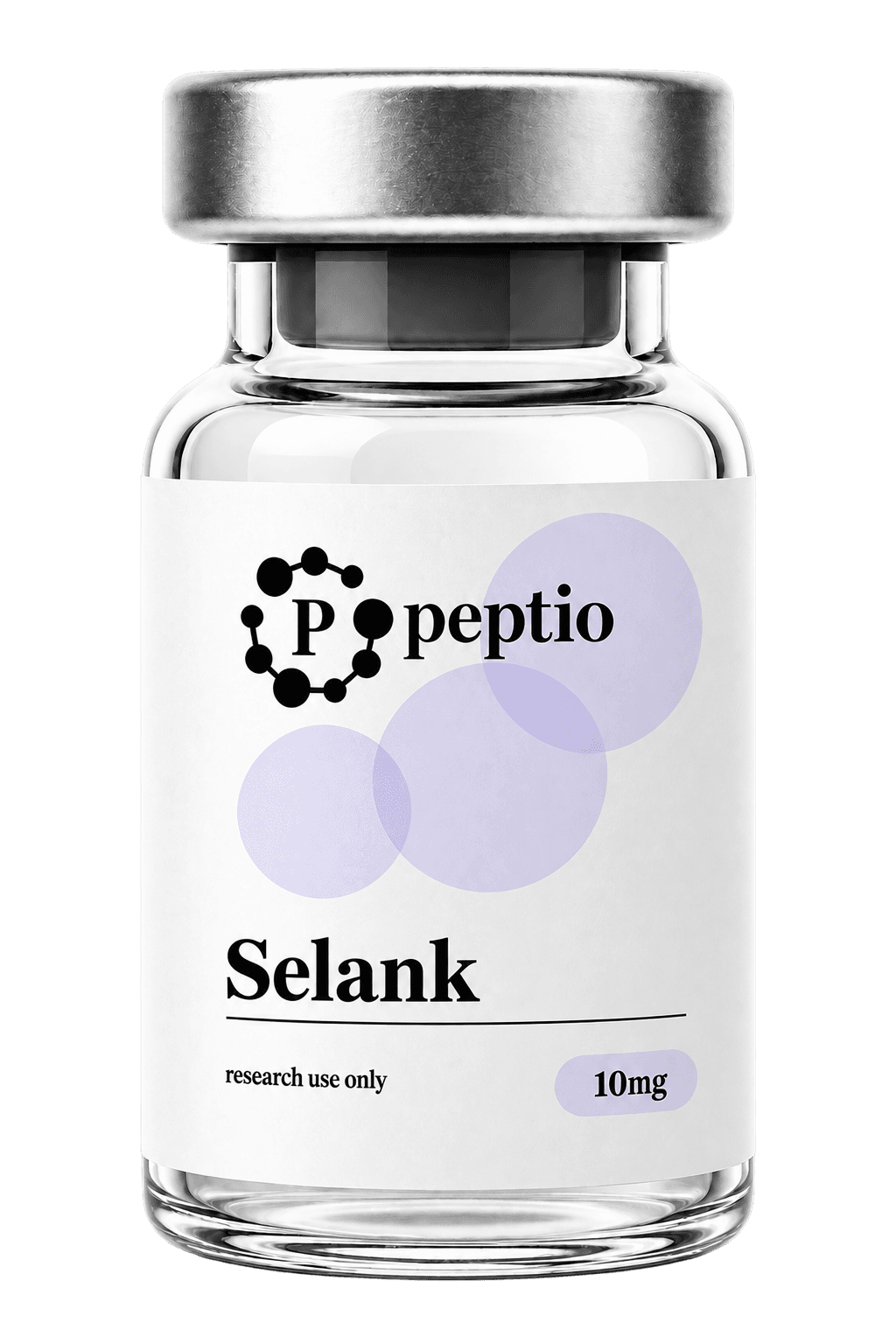
A sealed vial of lyophilised powder, in a 10 mg or a 30 mg size. Both are the same material; the difference is the mass in the vial, not the concentration — concentration is set later, by how much solvent is added. Neither is the Russian nasal preparation described above, and neither is a medicine.
Each batch is released against a certificate of analysis from an independent issuer, and the batch number printed on the vial matches the number on that certificate. Checking those two against each other is the most useful thing to do with a delivery. The purity, form, storage condition and molecular weight recorded for the current batch are in the specifications above.
Handling is the same as for every other compound in the catalogue. The handling protocol below covers storage temperatures, solvent choice and the concentration calculation.
Research use only
Selank is registered as a medicine in the Russian Federation and nowhere else. It holds no marketing authorisation in the European Union, the United Kingdom or the United States, and the material Peptio supplies is not that registered product. Peptio is not a pharmacy and supplies this compound for research use only — not for human or veterinary consumption. Everything reported on this page comes from published studies and describes their patients or their animals; none of it is guidance for use in people.
Handling and storage
Every compound Peptio ships arrives as a sealed vial of lyophilised powder. Freeze-drying is what keeps it stable in transit: with the water removed and the vial closed, the peptide keeps far longer than it would in solution. The protocol below applies to all of them, and it is the same protocol whichever compound is in the vial.
The steps that matter most happen in the first few minutes after a vial is opened, and in how the prepared solution is labelled afterwards. A vial with no recorded solvent volume is a vial with no known concentration, and no amount of care later recovers that.
From delivery to prepared solution
01
Inspect on arrival
Check that the crimp seal and stopper are intact and that the powder cake is dry and unbroken. Compare the batch number printed on the vial with the number on the certificate of analysis. A cake that has slumped into a film, or a vial that arrives loose in its packaging, is worth photographing before anything else is done to it.
02
Equilibrate before opening
Let a vial taken from cold storage stand sealed until it reaches room temperature. Opening cold glass in a warm room pulls condensation onto it, and moisture is the one thing a desiccated powder is being protected from.
03
Add the solvent
Direct the solvent slowly down the inner wall of the vial rather than onto the cake, then let it dissolve on its own and swirl gently until the solution runs clear. This takes a minute or two, and it is not helped by shaking.
04
Label, then refrigerate
Write the date, the solvent and the exact volume added onto the vial before it goes anywhere. Keep the prepared solution cold and out of direct light, and check that it is still clear each time it is used.
Quick reference
- Form
- Lyophilised powder in a sealed, stoppered vial
- Solvent
- Bacteriostatic water where the vial will be drawn from more than once; sterile water where it will not
- Typical reconstitution volume
- 1–3 mL, chosen to give the concentration the work calls for
- Storage before reconstitution
- −20 °C, desiccated and protected from light
- Storage after reconstitution
- 2–8 °C, protected from light, in the original stoppered vial
- In transit
- Short periods at 2–8 °C are expected; that is what the insulated mailer is for
- Once opened
- Record the date on the vial. How long a prepared solution stays usable depends on the solvent and the storage temperature, so the date is the only reliable reference point.
Handling
| Correct | Common mistake |
|---|---|
| Direct the solvent down the inner wall of the vial and let the cake dissolve on its own. | Drive the solvent onto the powder in a fast stream. |
| Swirl gently until the solution runs clear. | Shake or vortex the vial — mechanical agitation and foaming degrade peptide structure. |
| Let a vial from cold storage reach room temperature while it is still sealed. | Open a vial straight out of the freezer, and pull condensation into a product that is kept dry on purpose. |
| Label every prepared vial with the date, the solvent and the volume added. | Rely on memory — two vials that look identical at 2–8 °C can hold two different concentrations. |
| Draw through the stopper with a fresh sterile needle each time. | Prise off the crimp seal; an open vial cannot be kept sterile. |
| Keep prepared solution cold and shielded from light between uses. | Leave a reconstituted vial standing at room temperature on the bench. |
| Look at the solution before every use and confirm it is clear. | Use a solution that has turned cloudy or thrown a visible particle. |
Solvent volume sets the concentration
The mass of peptide in a vial is fixed at manufacture. The only variable is how much solvent goes in, and it changes every measurement that follows — 2 mL instead of 1 mL halves the concentration. Confirm the vial's usable capacity before adding anything, since a 2 mL vial will not take 3 mL, and write down the volume you actually added.
Working out the concentration
- Concentration (mg/mL) = peptide mass in the vial (mg) ÷ solvent volume added (mL).
- A 5 mg vial with 1 mL of solvent gives 5 mg/mL. The same vial with 2 mL gives 2.5 mg/mL.
- A 10 mg vial with 2 mL of solvent also gives 5 mg/mL — the same concentration from twice the mass.
- Volume (mL) = mass required (mg) ÷ concentration (mg/mL).
- 1 mg/mL is 1,000 micrograms per mL. Convert once, at the start, and hold one unit for the whole calculation.
Questions
About Selank
Delivery
- One delivery option at checkout: standard, 3–5 working days.
- Orders ship in an insulated mailer.
- Delivery is free on orders over €150.00.
- See the Shipping page for the delivery terms in full.
Customer reviews
0.0
0 reviews
- 50
- 40
- 30
- 20
- 10
No reviews yet.
Related compounds
In stock
In stockBestseller
In stockBestseller