In stockBestseller
For research use only · Not for human consumption
Thymosin Beta-4 is a peptide of 43 amino acids found in most mammalian cells, where it binds monomeric actin and holds it back from the polymerising pool. Safer and colleagues settled its identity in 1991, showing that the actin-sequestering peptide isolated from human platelets and the thymic peptide already known as thymosin beta 4 were the same molecule, and that it binds actin monomers one to one (1).
TB-500 is not that molecule. When Esposito and colleagues took a TB-500 preparation apart by high-resolution mass spectrometry, what they identified was a seven-residue piece of it — Ac-LKKTETQ, positions 17 to 23 of Thymosin Beta-4, with the amino terminus artificially acetylated (2).
That stretch is not an arbitrary one. Sosne and colleagues mapped the parent protein's activities onto short sequences and placed angiogenesis, wound healing and cell migration on LKKTETQ plus one adjacent residue — the central actin-binding domain — while a separate amino-terminal fragment, Ac-SDKP, carried the anti-inflammatory and anti-fibrotic activity (3).
The distance between the two matters more than the shared name suggests. The full-length protein has been through Phase 1, Phase 2 and Phase 3 trials in people; the fragment has not. Wherever this page reports a human figure, it says which of the two produced it. TB-500 holds no marketing authorisation anywhere, and everything below describes what a published study measured rather than a protocol for anyone to follow.
Actin
Sequestration of actin monomers
The parent protein binds monomeric actin one to one and holds it out of the polymerising pool, which is why it is described as an actin-sequestering peptide rather than a receptor ligand (1). TB-500 carries that binding site and none of the rest of the molecule, and no published study has put the two side by side.
ILK–Akt
A survival signalling complex
Bock-Marquette and colleagues reported that full-length Thymosin Beta-4 formed a complex with PINCH and integrin-linked kinase, activating the survival kinase Akt. After coronary artery ligation in mice, treatment raised integrin-linked kinase and Akt activity in the heart and improved early myocyte survival (12). This work used the whole protein.
Vessels
Angiogenesis and matrix remodelling
In a rat full-thickness wound model, full-length Thymosin Beta-4 given topically or intraperitoneally produced faster reepithelialisation than saline controls, with more collagen deposited and more new vessels in the treated wounds (13). That the fragment reproduces this arm through the binding site it carries is a proposal, not a demonstration.
The literature on TB-500 itself is small, and most of it was written by analytical chemists rather than clinicians. Esposito and colleagues identified the contents of a TB-500 preparation as Ac-LKKTETQ, then synthesised the same peptide to confirm it (2). Ho and colleagues built a doping-control assay for it and confirmed both the peptide and its metabolites in urine and plasma from horses after a single administration (4).
Rahaman and colleagues followed the fragment through human serum, enzyme preparations and rat urine. They reported Ac-LK as the metabolite present at the highest concentration early on, with Ac-LKK still detectable at 72 hours, and found that the wound-healing activity in their cell assays sat with a longer metabolite, Ac-LKKTE. Their conclusion is worth reading twice: the activity attributed to TB-500 in earlier work may belong to a metabolite rather than to the intact fragment (5).
The closest thing to an efficacy study is a rat experiment published in 2026. Thirty-two rats had the Achilles tendon transected and repaired, then received intraperitoneal BPC-157, TB-500, both, or nothing for four weeks. The authors reported improved histopathological parameters and extracellular matrix organisation with both peptides, a biomechanical advantage for TB-500 at four weeks, and no additional benefit from combining them (6).
That is close to the whole of the direct evidence. A Phase 1/2 trial of the 17-23 fragment opened in February 2026 in adults with stable atherosclerotic cardiovascular disease, with eighty participants planned and primary completion estimated for February 2027. It is recruiting and has posted no results (10).
Thymosin Beta-4 itself has a far longer record, and it is the source of most of what circulates about TB-500. In the rat wound model above, reepithelialisation was 42% greater than saline controls at four days and as much as 61% greater at seven (13). After coronary artery ligation in mice, the protein raised integrin-linked kinase and Akt activity, improved early myocyte survival and improved cardiac function (12). Both are animal results, and both used the whole protein.
In people, four cohorts of ten healthy volunteers each received a single intravenous dose of synthetic Thymosin Beta-4 at 42, 140, 420 or 1,260 mg, then the same dose daily for fourteen days. The report describes infrequent adverse events, mild or moderate in intensity, with no dose-limiting toxicity (7). Those figures are trial design, given here because the result cannot be read without them, and they belong to the full-length protein.
The ophthalmic programme went furthest. A Phase 2 trial of a 0.1% Thymosin Beta-4 eye drop in nine patients with severe dry eye reported improvements in discomfort and in corneal staining against vehicle (8), and a Phase 3 trial in neurotrophic keratopathy reported complete healing of the epithelial defect at four weeks in 6 of 10 treated patients against 1 of 8 on placebo (9). Two further Phase 3 dry eye trials, ARISE-2 and ARISE-3, enrolled 601 and 700 participants and are recorded as completed (14).
None of it was done with TB-500.
These three share a shelf and very little else. Each column reports what the studies cited beneath the table actually did — where the peptide comes from, the pathway proposed for it, the stage its evidence has reached, the species and the route. No cell here is a measure of effect, because for none of the three is there a controlled human result to put in one. Nothing in the table is a head-to-head comparison, with a single exception: the rat tendon study tested TB-500 and BPC-157 in the same experiment (6).
| Parameter | TB-500 | BPC-157 | KPV |
|---|---|---|---|
| What it is a fragment of | Thymosin Beta-4, a 43-residue actin-binding protein; the preparation analysed was Ac-LKKTETQ, positions 17 to 23 (1, 2) | Described in the literature as a stable gastric pentadecapeptide — fifteen residues (15) | Alpha-melanocyte-stimulating hormone; a tripeptide, Lys-Pro-Val, derived from it (16) |
| Pathway proposed in the cited work | Binding at the actin-sequestering site; the parent protein's activities mapped to this sequence are cell migration, angiogenesis and wound healing (1, 3) | No single receptor is proposed; the reviews describe pleiotropic effects across gastrointestinal, tendon and central nervous system models (15) | Uptake by the PepT1 di- and tripeptide transporter, followed by reduced inflammatory signalling in intestinal epithelial and immune cells (17) |
| Evidence stage | Preclinical. One Phase 1/2 human trial is registered and recruiting, with no results posted (10) | Preclinical in the work cited here (6, 15) | Preclinical in the work cited here (17) |
| Species and model in those studies | Rats, Achilles tendon transection and repair; horses, doping-control administration; human serum and cultured cells (4, 5, 6) | Rats — the same Achilles tendon experiment, and separately models of stroke and spinal cord injury (6, 15) | Mice, in two chemically induced colitis models (17) |
| Route used in those studies | Intraperitoneal in the rat tendon study; a single administration in the equine work (4, 6) | Intraperitoneal in the same rat tendon study (6) | Added to the drinking water — oral — in the colitis models (17) |
| Regulatory status | No marketing authorisation in any jurisdiction; reviewed as an unapproved peptide (18) | No marketing authorisation in any jurisdiction; reviewed as an unapproved peptide (18) | No marketing authorisation in any jurisdiction |
Sources. (1) Safer D, Elzinga M, Nachmias VT. Thymosin beta 4 and Fx, an actin-sequestering peptide, are indistinguishable. J Biol Chem. 1991;266(7):4029–4032. (2) Esposito S, Deventer K, Goeman J, Van der Eycken J, Van Eenoo P. Synthesis and characterization of the N-terminal acetylated 17-23 fragment of thymosin beta 4 identified in TB-500, a product suspected to possess doping potential. Drug Test Anal. 2012;4(9):733–738. (3) Sosne G, Qiu P, Goldstein AL, Wheater M. Biological activities of thymosin β4 defined by active sites in short peptide sequences. FASEB J. 2010;24(7):2144–2151. (4) Ho EN, Kwok WH, Lau MY, et al. Doping control analysis of TB-500, a synthetic version of an active region of thymosin β4, in equine urine and plasma by liquid chromatography-mass spectrometry. J Chromatogr A. 2012;1265:57–69. (5) Rahaman KA, Muresan AR, Min H, et al. Simultaneous quantification of TB-500 and its metabolites in in-vitro experiments and rats by UHPLC-Q-Exactive orbitrap MS/MS and their screening by wound healing activities in-vitro. J Chromatogr B Analyt Technol Biomed Life Sci. 2024;1235:124033. (6) Biçer O, Adanir O, Güleryüz Y, et al. Effects of BPC-157 and TB-500 on Achilles tendon healing in rats: a histopathological and biomechanical study. Jt Dis Relat Surg. 2026;37(3):822–837. (15) Vukojevic J, Milavić M, Perović D, et al. Pentadecapeptide BPC 157 and the central nervous system. Neural Regen Res. 2022;17(3):482–487. (16) Sun J, Xue P, Liu J, et al. Self-cross-linked hydrogel of cysteamine-grafted γ-polyglutamic acid stabilized tripeptide KPV for alleviating TNBS-induced ulcerative colitis in rats. ACS Biomater Sci Eng. 2021;7(10):4859–4869. (17) Dalmasso G, Charrier-Hisamuddin L, Nguyen HT, Yan Y, Sitaraman S, Merlin D. PepT1-mediated tripeptide KPV uptake reduces intestinal inflammation. Gastroenterology. 2008;134(1):166–178. (18) Mendias CL, Awan TM. Safety and efficacy of approved and unapproved peptide therapies for musculoskeletal injuries and athletic performance. Sports Med. 2026. doi:10.1007/s40279-026-02437-0. Cited elsewhere on this page: (7) Ruff D, Crockford D, Girardi G, Zhang Y. A randomized, placebo-controlled, single and multiple dose study of intravenous thymosin beta4 in healthy volunteers. Ann N Y Acad Sci. 2010;1194:223–229. (8) Sosne G, Dunn SP, Kim C. Thymosin β4 significantly improves signs and symptoms of severe dry eye in a phase 2 randomized trial. Cornea. 2015;34(5):491–496. (9) Sosne G, Kleinman HK, Springs C, Gross RH, Sung J, Kang S. 0.1% RGN-259 (thymosin β4) ophthalmic solution promotes healing and improves comfort in neurotrophic keratopathy patients in a randomized, placebo-controlled, double-masked phase III clinical trial. Int J Mol Sci. 2022;24(1):554. (10) ClinicalTrials.gov NCT07487363, a phase 1/2 dose-escalation study of TB-500 (thymosin beta 4 17-23 fragment) in adults with stable atherosclerotic cardiovascular disease; recruiting, no results posted. (11) U.S. Anti-Doping Agency. 2018 Prohibited List: summary of major changes. (12) Bock-Marquette I, Saxena A, White MD, DiMaio JM, Srivastava D. Thymosin beta4 activates integrin-linked kinase and promotes cardiac cell migration, survival and cardiac repair. Nature. 2004;432(7016):466–472. (13) Malinda KM, Sidhu GS, Mani H, et al. Thymosin beta4 accelerates wound healing. J Invest Dermatol. 1999;113(3):364–368. (14) ClinicalTrials.gov NCT02974907 (ARISE-2) and NCT03937882 (ARISE-3), phase 3 studies of RGN-259 ophthalmic solution in dry eye syndrome. TB-500 is an unapproved compound and holds no marketing authorisation in any jurisdiction.
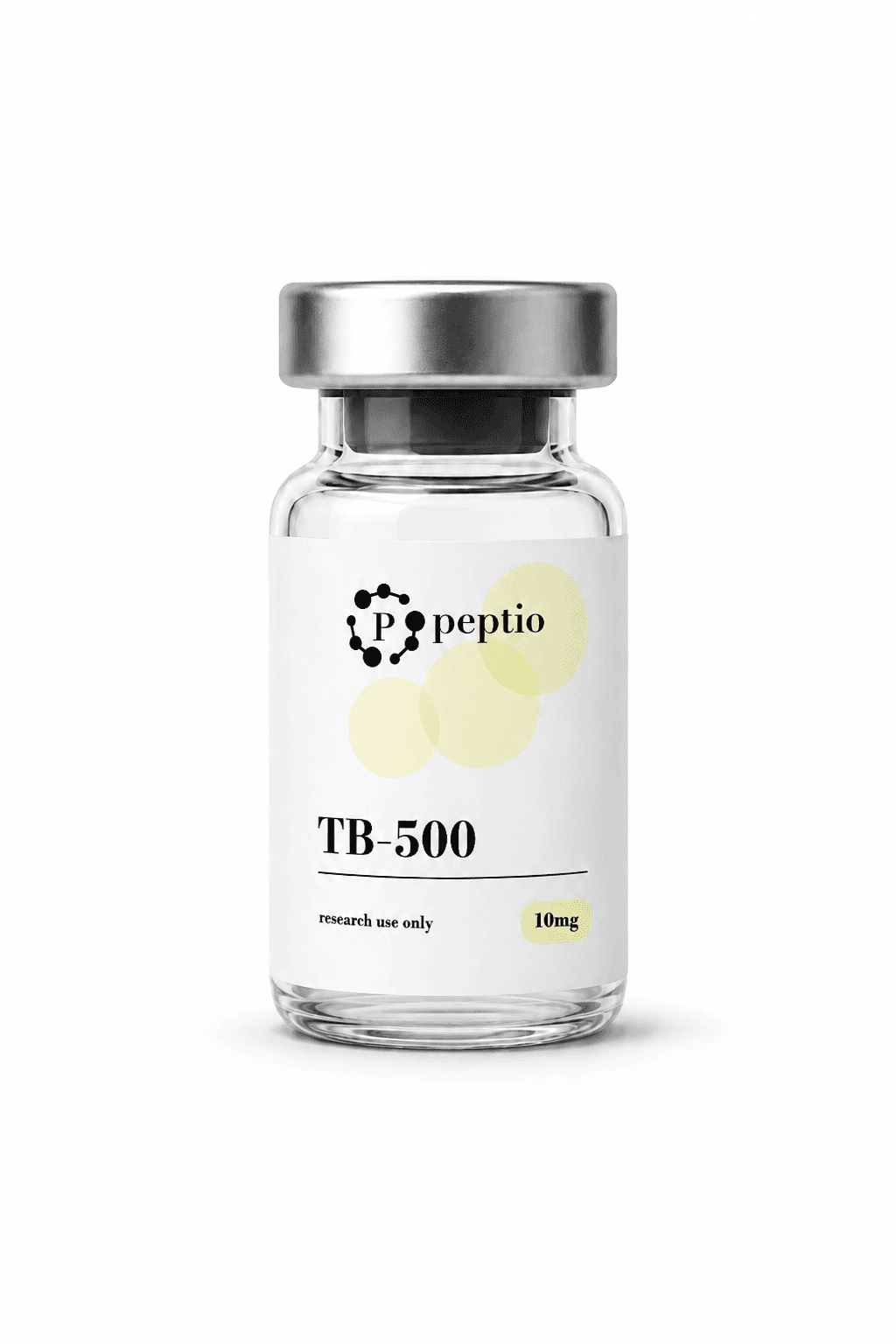
A sealed vial of lyophilised powder, in a 5 mg or a 10 mg size. Both are the same material; the difference is the mass in the vial, not the concentration — concentration is set later, by how much solvent is added.
Each batch is released against a certificate of analysis from an independent issuer, and the batch number printed on the vial matches the number on that certificate. Checking those two against each other is the most useful thing to do with a delivery, and it carries more weight here than for most compounds: TB-500 is a product name rather than a chemical one, so the certificate and the specifications above are what record which material is in the vial. The purity, form, storage condition and molecular weight held for the current batch are in those specifications.
Handling is the same as for every other compound in the catalogue. The handling protocol below covers storage temperatures, solvent choice and the concentration calculation.
Research use only
TB-500 is an unapproved compound with no marketing authorisation in any jurisdiction. Peptio is not a pharmacy and supplies it for research use only — not for human or veterinary consumption. The studies described on this page were carried out in cultured cells, in rats and in horses, or — where the page says so — with full-length Thymosin Beta-4 rather than with this fragment. None of it is guidance for use in people.
Every compound Peptio ships arrives as a sealed vial of lyophilised powder. Freeze-drying is what keeps it stable in transit: with the water removed and the vial closed, the peptide keeps far longer than it would in solution. The protocol below applies to all of them, and it is the same protocol whichever compound is in the vial.
The steps that matter most happen in the first few minutes after a vial is opened, and in how the prepared solution is labelled afterwards. A vial with no recorded solvent volume is a vial with no known concentration, and no amount of care later recovers that.
01
Inspect on arrival
Check that the crimp seal and stopper are intact and that the powder cake is dry and unbroken. Compare the batch number printed on the vial with the number on the certificate of analysis. A cake that has slumped into a film, or a vial that arrives loose in its packaging, is worth photographing before anything else is done to it.
02
Equilibrate before opening
Let a vial taken from cold storage stand sealed until it reaches room temperature. Opening cold glass in a warm room pulls condensation onto it, and moisture is the one thing a desiccated powder is being protected from.
03
Add the solvent
Direct the solvent slowly down the inner wall of the vial rather than onto the cake, then let it dissolve on its own and swirl gently until the solution runs clear. This takes a minute or two, and it is not helped by shaking.
04
Label, then refrigerate
Write the date, the solvent and the exact volume added onto the vial before it goes anywhere. Keep the prepared solution cold and out of direct light, and check that it is still clear each time it is used.
| Correct | Common mistake |
|---|---|
| Direct the solvent down the inner wall of the vial and let the cake dissolve on its own. | Drive the solvent onto the powder in a fast stream. |
| Swirl gently until the solution runs clear. | Shake or vortex the vial — mechanical agitation and foaming degrade peptide structure. |
| Let a vial from cold storage reach room temperature while it is still sealed. | Open a vial straight out of the freezer, and pull condensation into a product that is kept dry on purpose. |
| Label every prepared vial with the date, the solvent and the volume added. | Rely on memory — two vials that look identical at 2–8 °C can hold two different concentrations. |
| Draw through the stopper with a fresh sterile needle each time. | Prise off the crimp seal; an open vial cannot be kept sterile. |
| Keep prepared solution cold and shielded from light between uses. | Leave a reconstituted vial standing at room temperature on the bench. |
| Look at the solution before every use and confirm it is clear. | Use a solution that has turned cloudy or thrown a visible particle. |
Solvent volume sets the concentration
The mass of peptide in a vial is fixed at manufacture. The only variable is how much solvent goes in, and it changes every measurement that follows — 2 mL instead of 1 mL halves the concentration. Confirm the vial's usable capacity before adding anything, since a 2 mL vial will not take 3 mL, and write down the volume you actually added.
Questions
0.0
0 reviews
No reviews yet.